254 questions asked across 4 exam years, newest first
Read the following statement carefully and identify the conclusion that follows. Statement: Most farmers in the region depend on monsoon rains for irrigation. Conclusions: I. The region does not have proper irrigation infrastructure. II. A weak monsoon may reduce agricultural output.
Answer: B
Instruction: Identify the assumptions that must hold for the statement to be valid, then choose the correct option. Statement: The discovery of exoplanets in habitable zones around distant stars has provided exciting prospects for the search for extraterrestrial life, yet the vast distances and technological limitations pose significant obstacles to direct exploration. Assumptions: I. Exoplanets located in habitable zones may have the potential to support life. II. Current technology is insufficient to directly explore exoplanets in habitable zones. III. Direct exploration of exoplanets will be unnecessary if we detect signs of life remotely.
Answer: A
Instruction: Identify the assumptions that must hold for the statement to be valid, then choose the correct option. Statement: While the world is moving towards automation, it is essential to ensure that ethical frameworks evolve alongside technological advancements to prevent misuse. Assumptions: I. Automation can lead to ethical dilemmas. II. Ethical frameworks must be updated to keep pace with technological advancements. III. Automation will eventually replace human labor in all sectors.
Answer: A
Read the given statements and conclusions carefully. Assuming that the information given in the statements is true, even if it appears to be at variance with commonly known facts, decide which of the given conclusion(s) logically follow(s) from the statements. Statements: All pastries are chocolates. Some chocolates are cookies. All cookies are cakes. Conclusions: (I) No pastry is a cake. (II) Some cakes are chocolates.
Answer: C
In this question, three statements are given, followed by two conclusions numbered I and II. Assuming the statements to be true, even if they seem to be at variance with commonly known facts, decide which of the conclusions logically follows/follow from the statements. Statements: All red are green. All green are pink. No pink is blue. Conclusions: I. No green is blue. II. Some blue are red.
Answer: B
Read the given statements and conclusions carefully. You have to take the given statements to be true even if they seem to be at variance from commonly known facts. You have to decide which conclusion(s) logically follow(s) from the given statements. Statements: All Grapes are Berries. Some Berries are Juices. All Juices are Sodas. Conclusions: (I) Some Berries are Grapes. (II) Some Sodas are Berries.
Answer: C
Three statements are given followed by three conclusions numbered I, II and III. Assuming the statements to be true, even if they seem to be at variance with commonly known facts, decide which of the conclusions logically follow(s) from the statements. Statements: Some cups are glasses. No glass is a stone. All stones are metals. Conclusions: I. All cups can never be stones. II. No cup is a metal. III. All metals can never be glasses.
Answer: B
In this question, three statements are given, followed by three conclusions numbered I, II, and III. Assuming the statements to be true, even if they seem to be at variance with commonly known facts, decide which of the conclusions logically follow(s) from the statements. Statements: All phones are TVs. Some TVs are big. Some big are cars. Conclusions: I. Some TVs are phones. II. Some big are TVs. III. All big are cars.
Answer: B
Read the given statements and conclusions carefully. Assuming that the information given in the statements is true, even if it appears to be at variance with commonly known facts, decide which of the given conclusions logically follow(s) from the statements. Statements: Some vegetables are fruits. Some fruits are flowers. All flowers are garlands. Conclusions: I. Some garlands are fruits. II. Some vegetables are flowers. III. Some vegetables are garlands.
Answer: D
Read the given statements and conclusions carefully. Assuming that the information given in the statements is true, even if it appears to be at variance with commonly known facts, decide which of the given conclusions logically follow from the statements. Statements: All papers are pencils. All pencils are erasers. All erasers are pens. Conclusions: I. All pens are papers. II. Some papers are erasers. III. Some pens are pencils.
Answer: C
Three statements are given, followed by three conclusions numbered I, II and III. Assuming the statements to be true, even if they seem to be at variance with commonly known facts, decide which of the conclusions logically follow(s) from the statements. Statements: All spoons are forks. All forks are knives. No knife is a spatula. Conclusions: I. Some knives are spoons. II. No fork is a spatula. III. Some spoons are spatulas.
Answer: C
In this question, three statements are given, followed by three conclusions numbered I, II and III. Assuming the statements to be true, even if they seem to be at variance with commonly known facts, decide which of the conclusions logically follow(s) from the statements. Statements: All necklaces are squares. Some squares are circles. No circle is a ring. Conclusions: I. No square is a ring. II. No ring is a circle. III. Some squares are necklaces.
Answer: B
In this question, three statements are given, followed by two conclusions numbered I and II. Assuming the statements to be true, even if they seem to be at variance with commonly known facts, decide which of the conclusion(s) logically follows/follow from the statements. Statements: All grains are cereals. Some cereals are fruits. No fruit is a vegetable. Conclusions: I. All cereals can be vegetables. II. All grains are fruits.
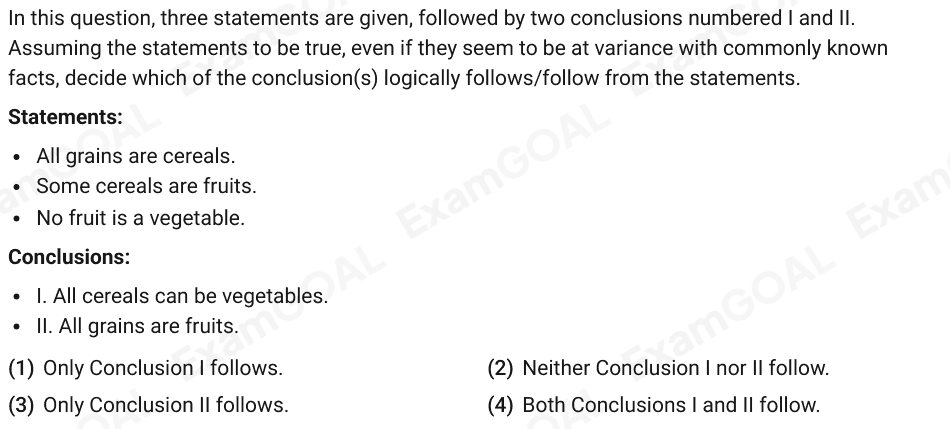
Answer: B
Read the given statements and conclusions carefully. Assuming that the information given in the statements is true, even if it appears to be at variance with commonly known facts, decide which of the given conclusion(s) logically follow(s) from the statements. Statements: Some eagles are sparrows. All sparrows are parrots. No parrot is a penguin. Conclusions: (I) Some parrots are eagles. (II) No penguin is a sparrow.
Answer: C
In this question, three statements are given, followed by two conclusions numbered I and II. Assuming the statements to be true, even if they seem to be at variance with commonly known facts, decide which of the conclusion(s) logically follows/follow from the statements. Statements: All teachers are dancers. All dancers are engineers. Some engineers are beautiful. Conclusions: I. All teachers are beautiful. II. Some dancers are beautiful.
Answer: A
In this question, three statements are given, followed by two conclusions numbered I and II. Assuming the statements to be true, even if they seem to be at variance with commonly known facts, decide which of the conclusion(s) logically follows/follow from the statements. Statements: Some shirts are pants. All pants are jackets. All jackets are trousers. Conclusions: I. Some trousers are shirts. II. All jackets are shirts.
Answer: A
Three statements are given, followed by three conclusions numbered I, II, and III. Assuming the statements to be true, even if they seem to be at variance with commonly known facts, decide which of the conclusions logically follow(s) from the statements. Statements: Some pineapples are oranges. All oranges are bananas. All bananas are plums. Conclusions: I. Some pineapples are plums. II. All oranges are plums. III. No pineapple is a banana.
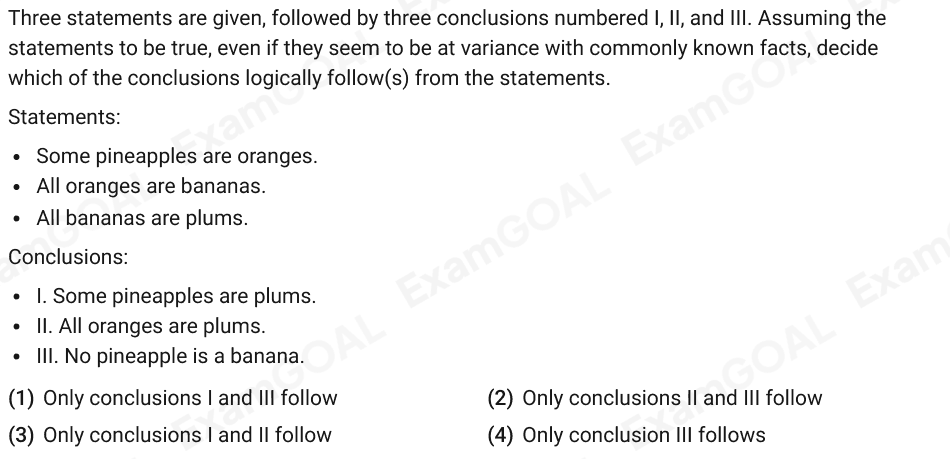
Answer: C
In this question, three statements are given, followed by two conclusions numbered I and II. Assuming the statements to be true, even if they seem to be at variance with commonly known facts, decide which of the conclusion(s) logically follows/follow from the statements. Statements: No medicine is a capsule. Some capsules are tablets. Some tablets are laptops. Conclusions: I. Some capsules are laptops. II. All tablets can never be medicines.
Answer: B
In this question, three statements are given, followed by three conclusions numbered I, II, and III. Assuming the statements to be true, even if they seem to be at variance with commonly known facts, decide which of the conclusions logically follow(s) from the statements. Statements: All cars are birds. Some birds are plants. All plants are leaves. Conclusions: I. Some birds are cars. II. Some plants are birds. III. Some leaves are plants.
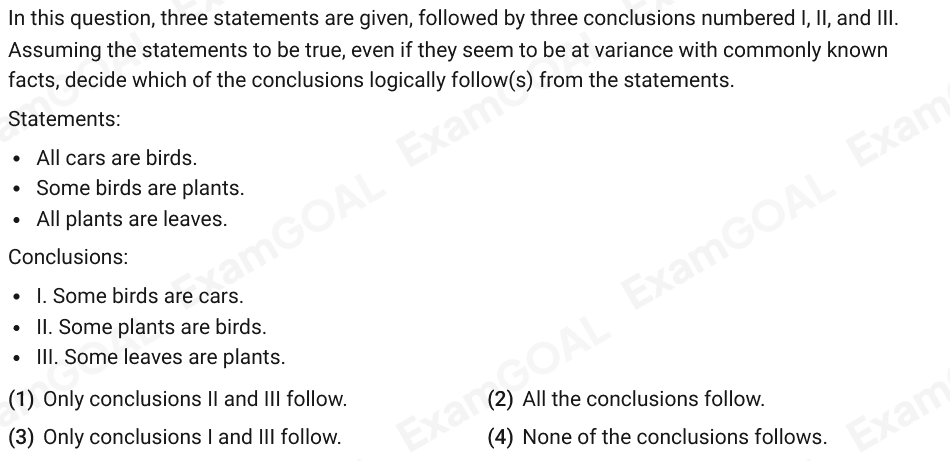
Answer: B
Read the given statements and conclusions carefully. Assuming that the information given in the statements is true, even if it appears to be at variance with commonly known facts, decide which of the given conclusions logically follow(s) from the statements. Statements: Some balls are toys. All circles are balls. All balls are pits. Conclusions: (I) Some circles are toys. (II) All pits are toys.
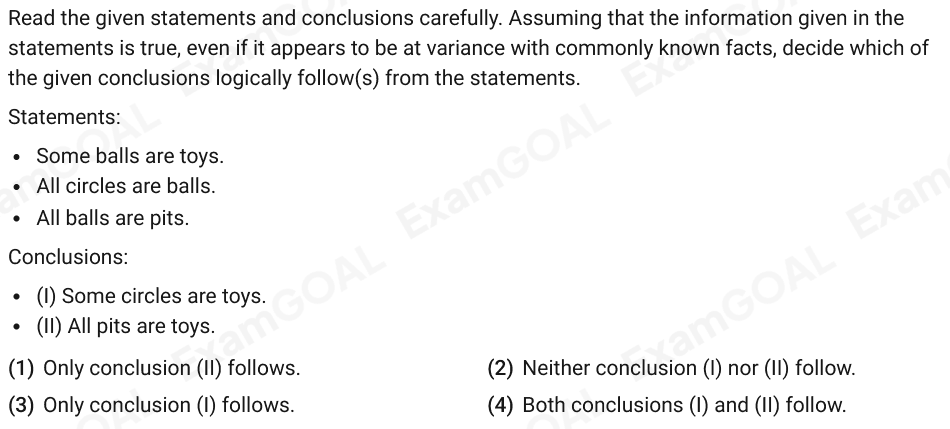
Answer: B
In this question, three statements are given, followed by three conclusions numbered I, II, and III. Assuming the statements to be true, even if they seem to be at variance with commonly known facts, decide which of the conclusions logically follow(s) from the statements. Statements: All computers are printers. Some printers are laptops. All laptops are mobiles. Conclusions: I. Some printers are computers. II. Some laptops are printers. III. Some mobiles are laptops.
Answer: D
Read the given statements and conclusions carefully. You have to take the given statements to be true even if they seem to be at variance from commonly known facts. You have to decide which conclusion/s logically follow/s from the given statements. Statements: Some telephones are curtains. All curtains are lamps. No lamps is books. Conclusions: (I) All lamps are telephones. (II) No books is lamps.
Answer: A
Three statements are given, followed by three conclusions numbered I, II, and III. Assuming the statements to be true, even if they seem to be at variance with commonly known facts, decide which of the conclusions logically follow(s) from the statements. Statements: Some circles are rectangles. Some rectangles are squares. All squares are triangles. Conclusions: I. No circle is a triangle. II. Some rectangles are triangles. III. All rectangles are triangles.
Answer: D
Read the given statements and conclusions carefully. Assuming that the information given in the statements is true, even if it appears to be at variance with commonly known facts, decide which of the given conclusions logically follow(s) from the statements. Statements: Some Toys are Plastic. Some Plastic are Metal. No Metal is Chemical. Conclusions: (I) Some Chemicals are Plastic. (II) No Toy is a Chemical.
Answer: C
Read the given statements and conclusions carefully. You have to take the given statements to be true if they seem to be at variance from commonly known facts. You have to decide which conclusion(s) logically follow(s) from the given statements. Statements: All fruit are sour. Some sour are vegetables. Some vegetables are green. Conclusions: (I) All vegetables are sour. (II) Some sour are green.
Answer: A
