254 questions asked across 4 exam years, newest first
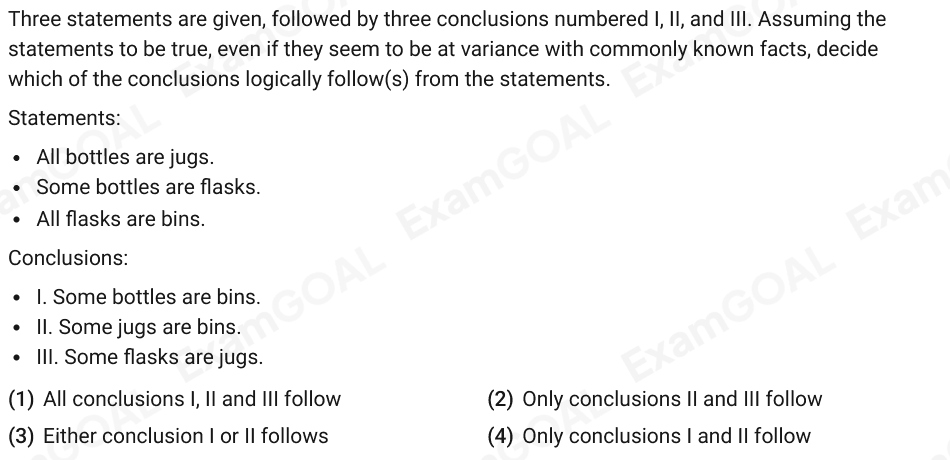
Three statements are given, followed by three conclusions numbered I, II, and III. Assuming the statements to be true, even if they seem to be at variance with commonly known facts, decide which of the conclusions logically follow(s) from the statements. Statements: All bottles are jugs. Some bottles are flasks. All flasks are bins. Conclusions: I. Some bottles are bins. II. Some jugs are bins. III. Some flasks are jugs.
Answer: A
Read the given statements and conclusions carefully. You have to take the given statements to be true even if they seem to be at variance from commonly known facts. You have to decide which conclusion/s logically follow/s from the given statements. Statements: All apples are mangoes. All mangoes are lemons. All lemons are kiwis. Conclusions: (I) All apples are lemons. (II) All mangoes are kiwis.
Answer: C
Three statements are followed by three conclusions numbered I, II and III. You have to consider these statements to be true, even if they seem to be at variance with commonly known facts. Decide which of the given conclusions logically follow/s from the given statements. Statements: All pens are pages. Some pages are pins. Some pins are boards. Conclusions: (I) Some pins are pens. (II) Some boards are pages. (III) Some pens are boards.
Answer: A
Three statements are given, followed by three conclusions numbered I, II and III. Assuming the statements to be true, even if they seem to be at variance with commonly known facts, decide which of the conclusions logically follow(s) from the statements. Statements: Some rats are mouse. No mouse is a rodent. Some rats are kittens. Conclusions: I. No rodent is a kitten. II. Some rats are rodent. III. No kitten is a mouse.
Answer: B
Read the given statements and conclusions carefully. Assuming that the information given in the statements is true, even if it appears to be at variance with commonly known facts, decide which of the given conclusions logically follow(s) from the statements. Statements: Some boxes are cartons. All cartons are papers. Some cartons are utensils. Conclusion (I): No box is a utensil. Conclusion (II): Some papers are utensils.
Answer: A
Read the given statements and conclusions carefully. Assuming that the information given in the statements is true, even if it appears to be at variance with commonly known facts, decide which of the given conclusions logically follow(s) from the statements. Statements: Some bags are purses. All purses are wallets. All wallets are sacks. Conclusions: (I) All purses are sacks. (II) Some wallets are bags.
Answer: C
Three statements are given, followed by three conclusions numbered I, II, and III. Assuming the statements to be true, even if they seem to be at variance with commonly known facts, decide which of the conclusions logically follow(s) from the statements. Statements: No bench is chair. All sofas are benches. All tables are sofas. Conclusions: (I) No table is a chair. (II) Some sofas are chairs. (III) All tables are benches.
Answer: C
