53 questions asked across 4 exam years, newest first
A invests ₹25,000 for 12 months, B invests ₹50,000 for 6 months. What is A's share of ₹30,000 profit?
Answer: C
A and B start a business with capitals in the ratio 5 : 3. After 6 months, A withdraws ₹10,000 and B doubles his investment. If the initial investment of A was ₹50,000, and the total profit after 1 year is ₹84,000, find the profit share of A.
Answer: A
X, Y, and Z invested ₹25,000, ₹35,000, and ₹40,000 respectively in a business. If the profit at the end of the year was ₹30,000, find Y's share.
Answer: A
A and B started a business by investing ₹48,000 and ₹72,000 respectively. After 6 months, A withdrew half of his capital, while B increased his capital by ₹24,000. At the end of the year, they earned a total profit of ₹55,000. What is B's share in the profit?
Answer: C
Tina and Meera started a business with ₹1,00,000 and ₹80,000 respectively. After 6 months, Meera added ₹40,000 more. Tina withdrew ₹20,000 at the same time. What is the profit-sharing ratio at the end of 1 year?
Answer: A
A tea seller bought 15 kg of Darjeeling tea at ₹300 per kg and 25 kg of Assam tea at ₹240 per kg. He mixed them together. Due to a slight drop in market prices, he had to sell the entire mixture at ₹260 per kg. Calculate his total profit or loss.
Answer: A
A, B, and C invested ₹40,000, ₹60,000, and ₹1,00,000 respectively in a business. If the total profit at the end of the year is ₹40,000, what is A's share of the profit?
Answer: B
A and B start a business. A invests 2 times more than B. After 8 months, A withdraws half of his capital, and B triples his capital. If the total profit after one year is ₹75,000, find the share of A.
Answer: D
Arvind started a business by investing ₹80,000. After 4 months, Bhavin joined with ₹1,20,000. At the end of 8 months from the start, Chandan joined with ₹1,60,000. If the total profit is ₹1,05,000 at the end of the year, find the share of Chandan.
Answer: D
A and B start a business. A invests ₹80,000 for 9 months, B invests ₹1,20,000 for 6 months. What is B's share of a ₹45,000 profit?
Answer: D
Suman purchased 25 liters of milk at ₹45 per liter and another 15 liters of milk at ₹50 per liter. She combined both quantities and then sold the entire mixture at ₹48 per liter. What was her total profit or loss?
Answer: B
A and B invest ₹40,000 and ₹60,000 respectively in a business. What is A's share in a profit of ₹50,000?
Answer: B
A and B invested ₹1,20,000 and ₹1,60,000 respectively. A remained for 10 months and B for 7 months. What is the total profit if B's share is ₹16,800?
Answer: A
If books bought at prices ranging from ₹200 to ₹260 are sold at prices ranging from ₹250 to ₹300, what is the greatest possible profit that might be made in selling 25 books?
Answer: A
A shopkeeper has a fault of 100 g in a 3 kg weight. He sold 3 kg of potatoes to Charu using the same faulty weight for ₹46. The cost price of the potatoes for the seller was ₹12 per kg. How much profit (in ₹) did he earn on the potatoes?
Answer: B
A merchant mixes two varieties of sugar of 5 kg and 3 kg, which costs him ₹4 and ₹6 per kg, respectively. What is the cost price (in ₹) of the mixture per kg?
Answer: C
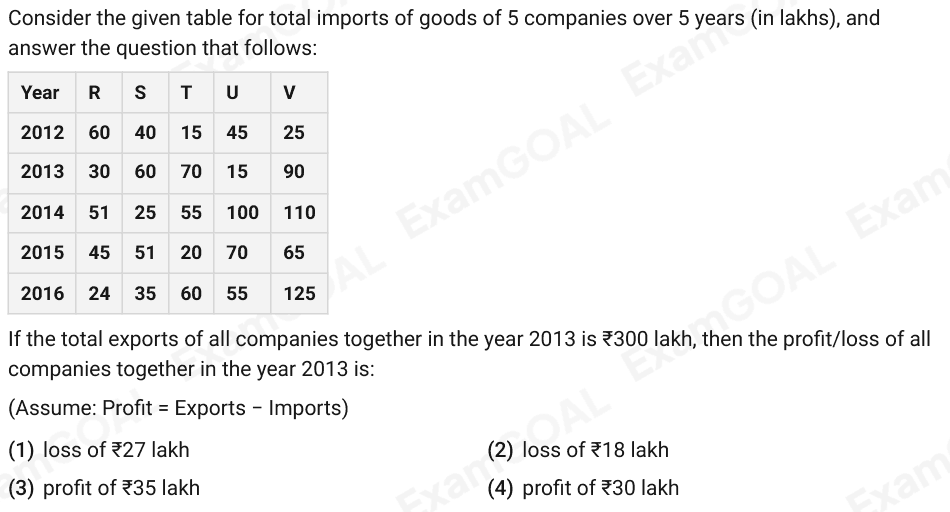
Consider the given table for total imports of goods of 5 companies over 5 years (in lakhs), and answer the question that follows: Year R S T U V 2012 60 40 15 45 25 2013 30 60 70 15 90 2014 51 25 55 100 110 2015 45 51 20 70 65 2016 24 35 60 55 125 If the total exports of all companies together in the year 2013 is ₹300 lakh, then the profit/loss of all companies together in the year 2013 is: (Assume: Profit = Exports − Imports)
Answer: C
The marked price of a microwave oven is ₹15,990 and it is sold for ₹12,792. What is the rate of discount offered?
Answer: B
A shopping mart offers four different discounts schemes on the sale of an object as follows:
Answer: B
A shopkeeper bought 20 chairs for ₹18,000. On selling them he had a gain equal to the selling price of four chairs. What is the selling price of each chair?
Answer: A
A table was bought for Rs. 3,000 and sold for Rs. 3,200. Find the gain or loss in terms of money.
Answer: A
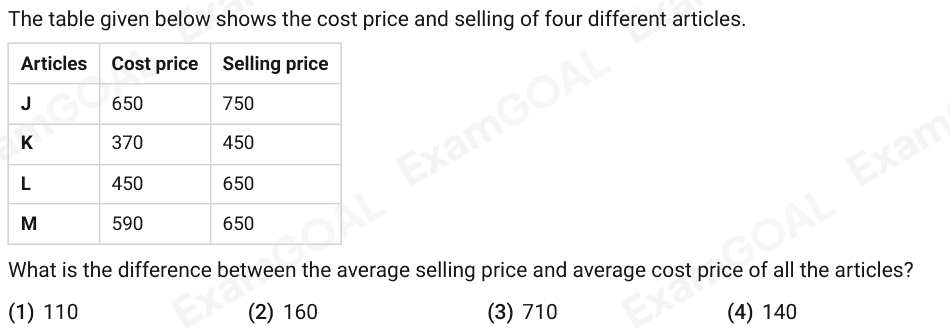
The table given below shows the cost price and selling of four different articles. Articles Cost price Selling price J 650 750 K 370 450 L 450 650 M 590 650 What is the difference between the average selling price and average cost price of all the articles?
Answer: A
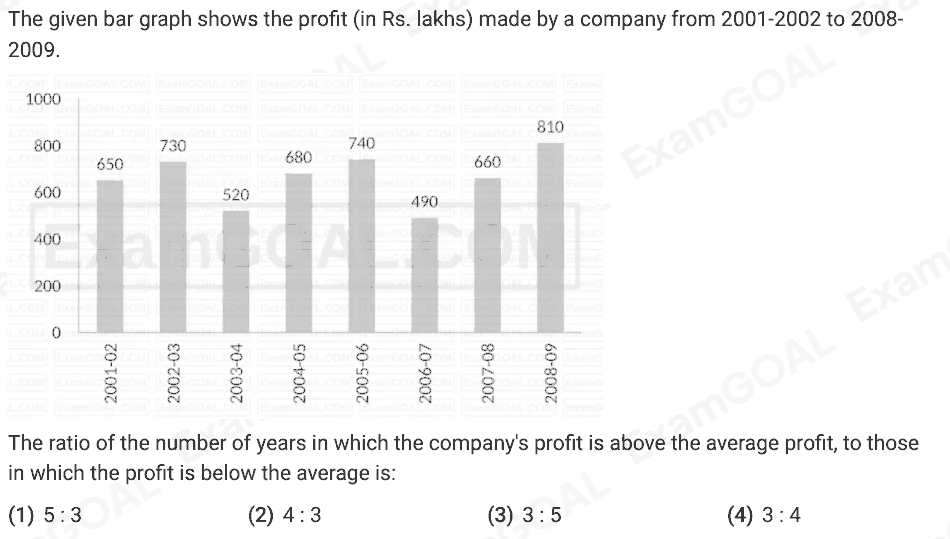
The given bar graph shows the profit (in Rs. lakhs) made by a company from 2001-2002 to 2008- 2009. The ratio of the number of years in which the company's profit is above the average profit, to those in which the profit is below the average is:
Answer: B
Nihit starts a business with Rs. 700. After 5 months Amit and Patel joined him with Rs. 300 and Rs. 400 respectively. At the end of the year, the business gave a profit of Rs. 627. Find the share of Patel in the profit.
Answer: C
If 3 coconuts are offered free on purchase of 12 coconuts, priced ₹25 each, what is the effective discount on each coconut?.
Answer: A
