802 questions asked across 4 exam years, newest first
A bookseller sells a novel for ₹Y and makes a loss of 10%. To clear old stock, he decides to mark the novel at ₹0.8Y. He then allows a further discount of 5% on this marked price. What will be the percentage loss that he will incur on this clearance sale?
Answer: D
An article is marked at ₹800. A shop owner allows a discount of 12% and still gains 8%. What is the approximate cost price of the article?
Answer: B
A furniture manufacturer sells a dining table set to a showroom at a 25% discount on the marked price, but adds a 10% handling fee on the discounted price. The showroom then sells the set for ₹4500 more than what they paid, thereby earning a profit of 30%. At what price had the manufacturer marked the dining table set?
Answer: B
A person invested ₹18,000 in two schemes — Scheme X at 15% p.a. and Scheme Y at 10% p.a., both under simple interest. After 1 year, the total interest from both schemes was ₹2,160. How much was invested in Scheme X?
Answer: C
A solid cylinder of radius 5 cm is drilled by four cylindrical holes, each of radius 1 cm and length equal to the full height. The volume removed is approximately what percent?
Answer: A
The average of 15 numbers is 80. The average of the first 6 numbers is 72. The average of the next 6 numbers is 25% more than the average of the first 6 numbers. The 13th number is 8 more than the 15th number, and the 14th number is 10 less than the 15th number. What is the average of the 13th and 14th numbers?
Answer: C
A landlord bought a flat for ₹8,00,000. He wants to earn a 9% annual return on his investment after paying ₹2,000 per month for maintenance. What should be the monthly rent he charges?
Answer: C
A toy manufacturer produced 1200 toy cars at a total cost of ₹90,000. He donated 200 cars to a charity event. For the rest, he announced a 10% discount on the market price of ₹120 per car. He also offered 2 toy cars free for every 8 toy cars purchased. If all 1200 toy cars were distributed, what is his overall gain or loss percentage?
Answer: A
A retailer marks an air conditioner 80% above its cost price. He offers a first discount of 25% on the marked price. During a festive offer, an additional discount of 10% is applied on the already discounted price. If the final selling price is ₹15,552, what is the approximate cost price of the air conditioner?
Answer: C
Two oils priced at ₹90 per kg and ₹150 per kg are blended and sold at ₹144 per kg, achieving a profit margin of 20%. What is the ratio of the two oils in the mixture?
Answer: A
A bullet train covers a fixed distance in 30 minutes at an average speed of 240 km/h. Due to track maintenance, it needs to be diverted, increasing the distance by 20%. If the train needs to arrive at its destination on time (i.e., in 30 minutes), what should its new average speed be in km/h?
Answer: C
A circular pizza having a radius of 21 cm. If 75% of it is eaten, what is the area of pizza remaining?
Answer: B
A bicycle wheel having a radius of 35 cm. What percentage of its circumference is covered in a quarter turn? (Use π=22/7)
Answer: B
A and B contribute to a business investment in the ratio 3:5. They earn a profit of ₹64,000. A is a working partner and receives 10% of the profit extra. What is A's total share?
Answer: B
The price of petrol shot up by 5%. Before the hike, the price was Rs. 82 per litre. A man travels 3045 km every month and his car gives a mileage of 15 km per litre. What is the increase in the monthly expenditure (to the nearest Rs.) on the man's travel due to the hike in the petrol prices?
Answer: B
A company placed an order for 20 high-end laptops and some quantity of standard desktops. The price of a high-end laptop was 5 times that of a standard desktop. Due to a mistake, the number of laptops and desktops was interchanged in the delivery. This caused the total bill to increase by 80%. What was the ratio of the number of high-end laptops to standard desktops in the original order?
Answer: D
Find the compound interest on ₹8,000 at 12% per annum for 3 years 4 months, compounded annually.
Answer: C
A candy shop owner buys three kinds of candies: red, blue, and green. Red candies are purchased at 3 for ₹15, blue candies at 4 for ₹18, and green candies at 5 for ₹22. He mixes them in the ratio 1:1:2. He sells all the mixed candies at 2 for ₹10. What is his approximate gain or loss percentage?
Answer: B
The expenditure of a household on food, clothing, and entertainment is in the ratio 2 : 4 : 4. In the coming year, the cost of food is expected to fall by 10%, clothing to rise by 5%, and entertainment to fall by 15%. What is the percent change (increase or decrease) in the total household expenditure?
Answer: C
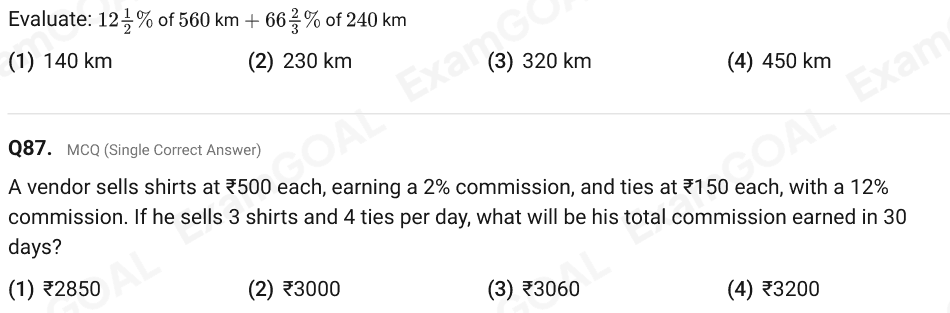
A vendor sells shirts at ₹500 each, earning a 2% commission, and ties at ₹150 each, with a 12% commission. If he sells 3 shirts and 4 ties per day, what will be his total commission earned in 30 days?
Answer: C
A fruit seller sells apples at a loss of 5% on the cost price but uses a weight that is 20% less than the actual weight. Find his total profit percentage.
Answer: D
The profit made on an item sold for ₹2200 is equal to the loss incurred when it is sold for ₹1800. What will be the profit or loss percentage if the item is sold for ₹2050?
Answer: C
A mobile phone retailer sells a phone for ₹P and earns a profit of 20%. For a special festive offer, he marks the same phone at ₹1.5P. At the offer, he provides a discount of 10%. What will be the percentage profit that he will make during the festive offer?
Answer: C
A shopkeeper marked an item 25% above its cost price. During a sale, he offered a discount of 10%. What was his profit percentage?
Answer: B
A shopkeeper marks his goods at 60% above the cost price. He allows a discount of 25% on the marked price. If he also gives an additional cash discount of ₹150, and still makes a profit of 14% on the cost price, what is the cost price of the goods?
Answer: B
