802 questions asked across 4 exam years, newest first
Seventy-five percent of a number is 15 more than two-thirds of that number. Find the number.
Answer: C
A TV set is available for ₹19,650 in cash or for ₹3,100 as a cash down payment and three equal annual instalments. If the shopkeeper charges interest at the rate of 10% per annum, compounded annually, calculate the amount of each instalment.
Answer: C
A mobile phone retailer sells a phone for ₹P and earns a profit of 20%. For a special festive offer, he marks the same phone at ₹1.5P. At the offer, he provides a discount of 10%. What will be the percentage profit that he will make during the festive offer?
Answer: C
A gadget is sold at a 15% discount on its marked price. This sale leads to a profit of 20% on its cost price. If the profit earned is ₹450, what would have been the selling price if the gadget was sold at a 25% discount on its marked price?
Answer: D
Two distinct grades of rice, one priced at ₹80 per kilogram and the other at ₹120 per kilogram, are mixed in an undisclosed proportion. The resultant blend is sold at ₹132 per kilogram, yielding a profit of 20% on the overall cost price. Determine the precise ratio in which the two rice varieties were mixed.
Answer: A
An individual invested certain amounts in three different schemes P, Q, and R at simple-interest rates of 7% p.a., 9% p.a., and 11% p.a. respectively. If the total interest accrued in one year was ₹2,520 and the amount invested in Scheme R was 250% of the amount invested in Scheme P and 300% of the amount invested in Scheme Q, what was the amount invested in Scheme P?
Answer: C
If 15% of a is equal to 25% of b, then find the ratio a : b.
Answer: B
An item is marked at ₹150. A customer gets a 10% discount on it. If the seller still makes a profit of 25%, what is the cost price of the item?
Answer: A
A software developer sells a license for a new application to a reseller at a 20% discount. An installation and support fee of 15% is added to the discounted price. The reseller then sells the license for ₹7800 more, making a 25% profit. Determine the original marked price of the software license by the developer.
Answer: D
In how many years will ₹50,000 become ₹66,550 at 10% compound interest per annum?
Answer: D
A sweet shop owner buys 10 boxes of sweets for the price of 8 boxes from a wholesaler. If he sells each box at a 2% discount on its marked price, what is his profit percentage? (Take the marked price equal to the wholesaler's price per box.)
Answer: C
A book publisher offers a novel to a bookstore at a 30% discount on the cover price. However, they charge an additional 5% on the discounted price for shipping. The bookstore sells the novel for ₹1620 more, earning a profit of 40%. What was the original cover price of the novel?
Answer: A
A and B invest ₹50,000 and ₹70,000 respectively in a business. After 1 year, the total profit is distributed including simple interest at 10% per annum on the capital of each partner. If the total profit including interest is ₹18,000, what is A's share of the profit?
Answer: B
Aman needed ₹30,000 for a start-up and split the sum between two private lenders under simple- interest terms: Lender A charges 9% p.a. (simple interest) Lender B charges 6% p.a. (simple interest) Aman kept both loans exactly 4 years and then made a single lump-sum payment that settled only the accumulated interest, which came to ₹9,600. After preparing his books of account, Aman discovered that if he had interchanged the principal amounts taken from the two lenders, his four- year interest outgo would have been ₹1,200 less than what he actually paid. How much of the original ₹30,000 did Aman borrow at 9% p.a. from Lender A?
Answer: D
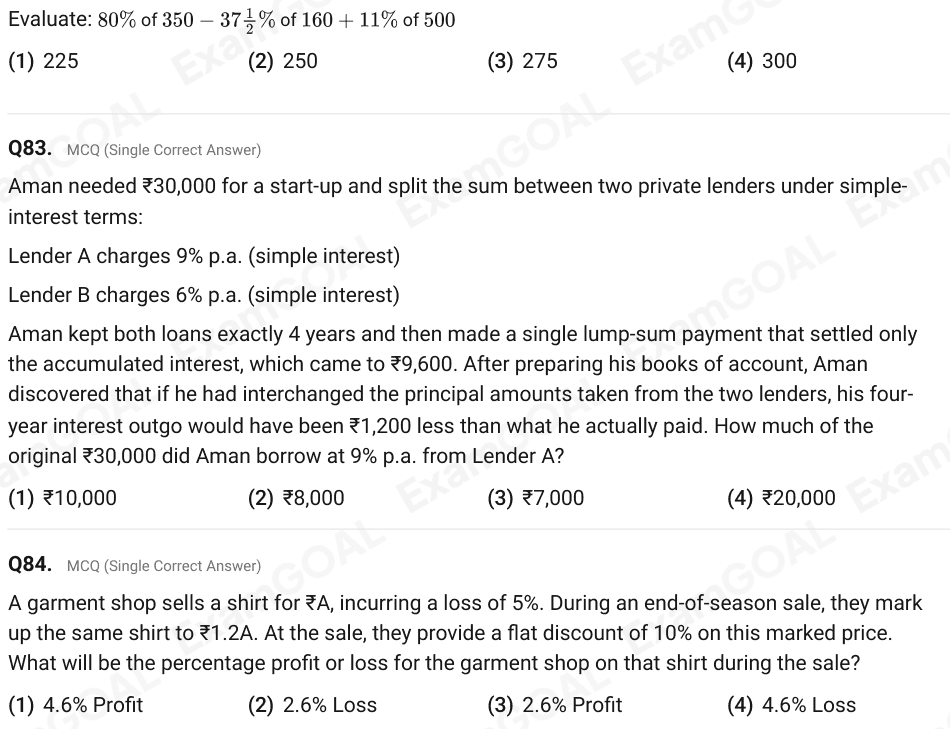
A garment shop sells a shirt for ₹A, incurring a loss of 5%. During an end-of-season sale, they mark up the same shirt to ₹1.2A. At the sale, they provide a flat discount of 10% on this marked price. What will be the percentage profit or loss for the garment shop on that shirt during the sale?
Answer: C
A shopkeeper marked an item 50% above its cost price. He then offered two successive discounts of 10% and 20% to a customer. If he made a profit of ₹80, at what price did he sell the item to that customer?
Answer: C
A shopkeeper has two types of pulses: one costing ₹60/kg and the other costing ₹90/kg. He mixes them in a specific ratio and sells the mixture at ₹84/kg, thereby earning a 20% profit. In what ratio did he mix the two types of pulses?
Answer: B
Sarah invested amounts in three different schemes M, N, and O at simple interest rates of 10% p.a., 12% p.a., and 15% p.a. respectively. If the total interest accrued in one year was ₹2282 and the amount invested in Scheme O was 180% of the amount invested in Scheme M and 250% of the amount invested in Scheme N, what was the amount invested in Scheme N?
Answer: C
In a competitive exam with 120 questions, there are three sections: General Knowledge (20 questions), Reasoning (50 questions), and English (50 questions). A candidate answered 70% of General Knowledge, 50% of Reasoning, and 30% of English questions correctly. If the minimum passing score is 60%, how many more questions did the candidate need to answer correctly to pass?
Answer: C
Find the compound interest on ₹7,000 at 9% p.a. for 1 year 8 months, compounded annually.
Answer: C
A stationery shop owner buys three types of notebooks. The first type costs him 5 notebooks for ₹20, the second 2 notebooks for ₹9, and the third 10 notebooks for ₹45. He mixes them in the ratio 3 : 4 : 3. If he sells all the notebooks at 4 for ₹19, what is his approximate gain or loss percentage?
Answer: B
A seller bought three different types of mobile covers, C1, C2, and C3. The ratio of their selling prices was 3:4:5. He made a profit of 25% on C1, 10% on C2, but incurred a loss of 20% on C3. What was his approximate percent gain or loss in the entire transaction?
Answer: B
A high-end watch is initially marked up by 50% above its cost price. During a sale, it is offered at a discount of 20% on its marked price. However, a special customer receives an additional discount of y% on the discounted price, bringing the final selling price to ₹4320. If the shopkeeper still makes a profit of 8% on the cost price after all discounts, what was the original cost price of the watch and the value of y?
Answer: A
A delivery van travels at a constant speed of 60 km/h to cover a certain route in 1 hour and 45 minutes. If traffic increases the time taken by 15 minutes, by what percentage must the van's average speed decrease to complete the route?
Answer: B
2.5% of 200 = ?
Answer: A
