218 questions asked across 4 exam years, newest first
In which year did Walther Flemming coined the term 'chromatin' for the stained substance found in the cell nucleus?
Answer: D
Which of the following elements has variable valency?
Answer: A
Which of the following is found in plant cells only?
Answer: B
Which of the following combinations of “animal” and “area they found” is INCORRECT ?
Answer: B
Vitamins and minerals are helpful for which of the following?
Answer: D
In the early 1800s, who discovered that each chemical element is made up of a unique type of atom and that atoms differ by their mass?
Answer: B
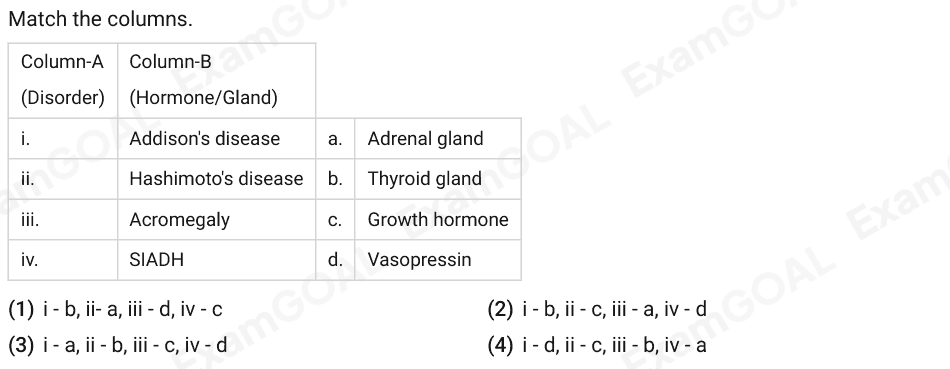
Match the columns. Column-A (Disorder) Column-B (Hormone/Gland) i. Addison's disease a. Adrenal gland ii. Hashimoto's disease b. Thyroid gland iii. Acromegaly c. Growth hormone iv. SIADH d. Vasopressin
Answer: C
Identify the element that does NOT belong to Period 6 of the Modern Periodic Table.
Answer: A
Which of the following statement is correct regarding cell membrane? I. The membrane is selectively permeable to some molecules present on either side of it. II. Water may also move across this membrane from lower to higher concentration.
Answer: B
Which form of leucoplast specialises in oil synthesis and storage and is mainly found in the layer of cells in pollen grains that develop pollen grains?
Answer: D
Which of the following organic compounds is synonymous with olefiant gas which is used to make anaesthetics, refrigerants and other chemicals?
Answer: A
In Which year did John Newlands propound the 'Law of Octaves' an innovative concept proposing the periodicity of chemical elements arranged in the order of atomic weight?
Answer: C
What do you call the glycocalyx when it is like a loose sheath in the cell envelope of bacteria?
Answer: C
Identify the last element from the fifth period.
Answer: D
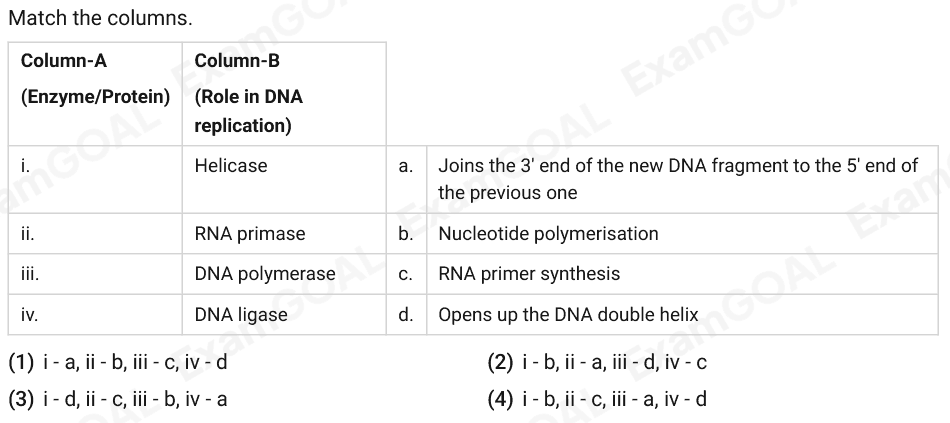
Match the columns. Column-A (Enzyme/Protein) Column-B (Role in DNA replication) i. Helicase a. Joins the 3' end of the new DNA fragment to the 5' end of the previous one ii. RNA primase b. Nucleotide polymerisation iii. DNA polymerase c. RNA primer synthesis iv. DNA ligase d. Opens up the DNA double helix
Answer: C
Which of the following group elements are called chalcogens?
Answer: A
What is an instrument that sends pulses of electromagnetic energy into the atmosphere to detect rainfall, determine its speed and intensity, and identify precipitation types such as rain, snow or hail?
Answer: D
What is the name of a metallic radioactive transuranic element with atomic number 101 in the actinide series, discovered in 1955?
Answer: C
Identify the animal that does NOT have bilateral symmetry.
Answer: D
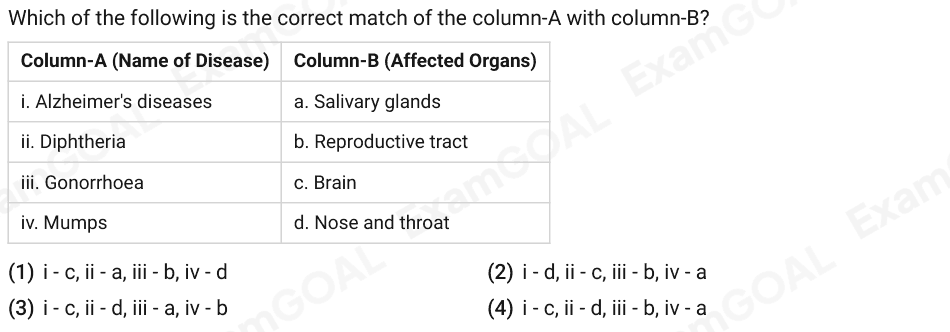
Which of the following is the correct match of the column-A with column-B? Column-A (Name of Disease) Column-B (Affected Organs) i. Alzheimer's diseases a. Salivary glands ii. Diphtheria b. Reproductive tract iii. Gonorrhoea c. Brain iv. Mumps d. Nose and throat
Answer: D
Select the option that is true regarding the following two statements labelled Assertion (A) and Reason (R). (A): An object slips less on a rough surface than a smooth surface. (R): When a surface is rough, frictional force increases.
Answer: D
Which element's atomic number in the periodic table is named seaborgium, according to the notation of IUPAC nomenclature?
Answer: B
Identify an organism that has a well-defined muscular pharynx.
Answer: A
Meandrina is the generic name of which Coelenterata animal having soft tube-shaped bodies that live together in large groups?
Answer: A
Which of the following is a synthetic fluorinated compound with an extremely stable molecular structure known to be the most potent greenhouse gas ever found?
Answer: C
