218 questions asked across 4 exam years, newest first
In Which year did John Newlands propound the 'Law of Octaves' an innovative concept proposing the periodicity of chemical elements arranged in the order of atomic weight?
Answer: C
What do you call the glycocalyx when it is like a loose sheath in the cell envelope of bacteria?
Answer: C
Identify the last element from the fifth period.
Answer: D
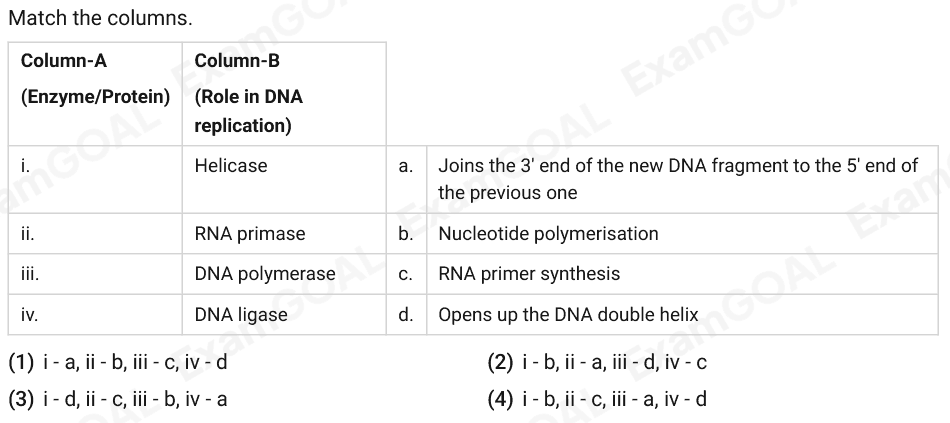
Match the columns. Column-A (Enzyme/Protein) Column-B (Role in DNA replication) i. Helicase a. Joins the 3' end of the new DNA fragment to the 5' end of the previous one ii. RNA primase b. Nucleotide polymerisation iii. DNA polymerase c. RNA primer synthesis iv. DNA ligase d. Opens up the DNA double helix
Answer: C
Which of the following group elements are called chalcogens?
Answer: A
What is an instrument that sends pulses of electromagnetic energy into the atmosphere to detect rainfall, determine its speed and intensity, and identify precipitation types such as rain, snow or hail?
Answer: D
What is the name of a metallic radioactive transuranic element with atomic number 101 in the actinide series, discovered in 1955?
Answer: C
Identify the animal that does NOT have bilateral symmetry.
Answer: D
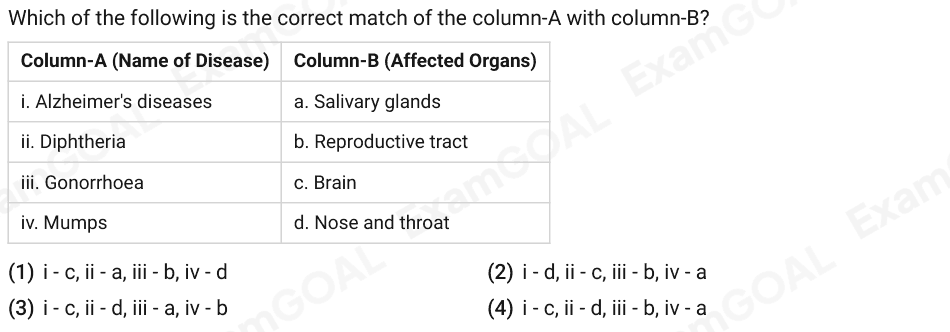
Which of the following is the correct match of the column-A with column-B? Column-A (Name of Disease) Column-B (Affected Organs) i. Alzheimer's diseases a. Salivary glands ii. Diphtheria b. Reproductive tract iii. Gonorrhoea c. Brain iv. Mumps d. Nose and throat
Answer: D
Select the option that is true regarding the following two statements labelled Assertion (A) and Reason (R). (A): An object slips less on a rough surface than a smooth surface. (R): When a surface is rough, frictional force increases.
Answer: D
Which element's atomic number in the periodic table is named seaborgium, according to the notation of IUPAC nomenclature?
Answer: B
Identify an organism that has a well-defined muscular pharynx.
Answer: A
Meandrina is the generic name of which Coelenterata animal having soft tube-shaped bodies that live together in large groups?
Answer: A
Which of the following is a synthetic fluorinated compound with an extremely stable molecular structure known to be the most potent greenhouse gas ever found?
Answer: C
In 1995, with whom did Eric Cornell experimentally produce the first Bose-Einstein condensate in a rarefied gas of rubidium atoms at extremely low temperatures?
Answer: A
In which year did E Gorter and F Grendel make a breakthrough by examining the surface area of lipids and concluded that the lipid surface surrounding cells must be of two layers?
Answer: B
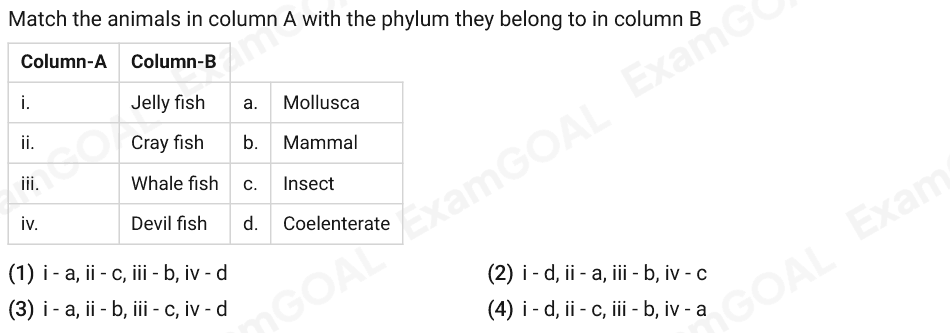
Match the animals in column A with the phylum they belong to in column B Column-A Column-B i. Jelly fish a. Mollusca ii. Cray fish b. Mammal iii. Whale fish c. Insect iv. Devil fish d. Coelenterate
Answer: D
Which is the first integrated steel plant in the public sector in India?
Answer: B
Which plant is considered a noxious weed that has a chemical defence mechanism to protect it from predators?
Answer: A
What is the percentage composition of the element of H2SO3?
Answer: D
In a plant, ________ is present in the middle lamella, primary cell and secondary walls and accumulates in the initial stages of development during cell expansion.
Answer: D
Whose law states that total energy per unit mass of flowing fluid, at any point in the subsurface, is the sum of the kinetic, potential, and fluid-pressure energy and is equal to a constant value?
Answer: A
What cells help In osmoregulation In platyhelminthes?
Answer: B
In cells, proteins are synthesised in _______.
Answer: D
Which of the following are metalloids?
Answer: C
