305 questions asked across 4 exam years, newest first
What was the key contribution of Baikuntha Shukla in the Indian freedom struggle?
Answer: C
Consider the statements about Dangi: 1. Performed by Dangi Adivasis of Dang district, Gujarat. 2. The dance is a solo narrative mimicking farm tools. Which is/are correct?
Answer: A
Who among the following was the key leader of the Khongjom War (1891) against British annexation of Manipur?
Answer: A
Which of the following sequences correctly arranges the Vijayanagara rulers in the order of their reign periods?
Answer: B
Which Rashtrakuta king defeated Parantaka I of the Chola dynasty?
Answer: C
Read the following statements carefully and choose the correct option regarding Assertion (A) and Reason (R). Assertion (A): The disinvestment policy has been widely criticized in India. Reason (R): It resulted in increased market monopoly by public sector undertakings.
Answer: C
The Salt Satyagraha of 1930 was a direct civil disobedience movement against which British policy?
Answer: B
What title did many Kushana rulers adopt to signify their divine status?
Answer: C
In the 2025 Global Firepower (GFP) review, which of the following statements is correct regarding the ranking methodology?
Answer: C
Which term-meaning pair is accurate in relation to the Gupta dynasty?
Answer: C
Which of the following kingdom was under the rule of the Sisodia dynasty during the 15th century?
Answer: C
How did Pitt's India Act contribute to unifying British administration in India?
Answer: C
Consider the statements about pawn promotion in chess: 1) A pawn can promote to any piece except king or pawn on reaching the other side. 2) Pawns can only promote to previously captured pieces. Which of the statements is/are correct?
Answer: A
According to the Gupta dynasty's administrative structure, which one of the following pairs of officer and role is correctly matched?
Answer: B
Read the following statements: Statement I: The Act of 1793 followed the tradition of personal rule without bringing in any legal reforms. Statement II: Judges were assigned to interpret laws rather than depend on the ruler's personal judgment. Which of the above statements is/are true?
Answer: B
The integration of the princely states into the Indian Union after 1947 involved a complex interplay of political negotiation, popular movements, and, at times, coercion. Which of the following factors most significantly undermined the initial aspirations of some princely rulers to maintain independent or autonomous status?
Answer: C
What was a major challenge for agriculture in the Chola kingdom apart from rocky land?
Answer: C
Which of the following Mughal tombs deviates from the typical square 'hasht-bihisht' (eight-part) layout?
Answer: B
Read the following statements carefully: Statement 1: The seals of the Harappan culture were made using locally found steatite. Statement 2: These seals often feature animal motifs and undeciphered script symbols. Which of the following is/are correct?
Answer: C
A key component evaluated by the 2025 Index of Economic Freedom concerning "Government Size" is:
Answer: B
In the context of Gupta dynasty's taxation, which pair is correct?
Answer: B
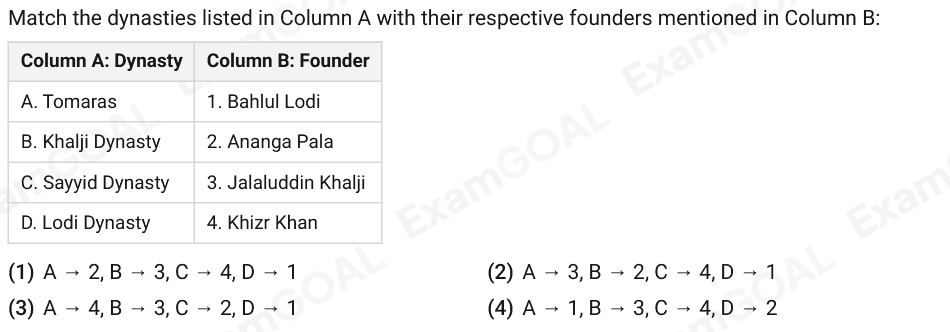
Match the dynasties listed in Column A with their respective founders mentioned in Column B: Column A: Dynasty Column B: Founder A. Tomaras 1. Bahlul Lodi B. Khalji Dynasty 2. Ananga Pala C. Sayyid Dynasty 3. Jalaluddin Khalji D. Lodi Dynasty 4. Khizr Khan
Answer: A
Who wrote 'An Era of Darkness: The British Empire in India'?
Answer: A
Fill in the blank: After defeating the Mughal emperor, _____ declared himself the ruler and founded the Second Afghan Empire.
Answer: B
What was the primary objective of the Ring-Fencing Policy adopted by the British in India during the 18th century?
Answer: C
