382 questions asked across 4 exam years, newest first
Which of the following pairs of temple style & region are correctly matched? 1. Vesara - Deccan 2. Rekha-Deul - Odisha 3. Bhumija - Malwa 4. Kalinga - Tamil Nadu
Answer: B
Which of the following is a folk song form of Jharkhand that reflects the lived experiences, social unity, and often accompanies dance and drama performances?
Answer: B
Who among the following Chola emperors constructed the grand temple at Gangaikonda Cholapuram?
Answer: B
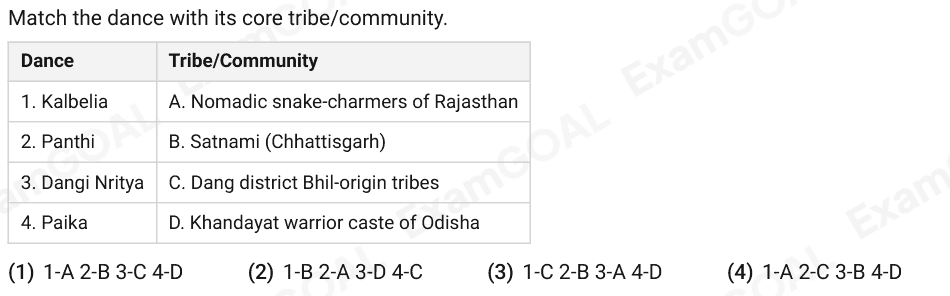
Match the dance with its core tribe/community. Dance Tribe/Community 1. Kalbelia A. Nomadic snake-charmers of Rajasthan 2. Panthi B. Satnami (Chhattisgarh) 3. Dangi Nritya C. Dang district Bhil-origin tribes 4. Paika D. Khandayat warrior caste of Odisha
Answer: A
The term 'svaravalis' refers to what in the context of Indian classical music?
Answer: B
During the Solung festival celebrated by the Adi tribe of Arunachal Pradesh, which traditional drink is shared to promote social bonding?
Answer: B
The festival of Bhagoria begins seven days before which Hindu festival?
Answer: B
Vilasini Natyam, once performed in temples and courts, is a classical dance form revived in which Indian state?
Answer: C
Match the dominant folk dance with the song-theme: Folk dance — Song-theme 1. Panthi — A. Devotional hymns to Guru Ghasidas (Hari-Gaitri) 2. Gotipua — B. Krishna-Jagannath leela narratives 3. Kalbelia — C. Sensuous serpent metaphors 4. Tippani — D. Work-song pounding couplets (saathiyo re)
Answer: A
Which of the following best describes Achal and Chal swaras in Indian classical music?
Answer: B
Fill in the blank: The hornbill bird, after which the festival is named, symbolizes boldness and _______ in Naga folklore.
Answer: C
Which one of the following pairs is correctly matched in accordance with Gupta's administration (Officer–Stated Role)?
Answer: C
Which classical musical treatise, composed in the 13th century CE by Sharangadeva in Maharashtra, is considered a foundational text in Indian musicology?
Answer: C
Fill in the Blank: Tippani dance uses _______ tools to pound the floor.
Answer: B
What makes Chhau a syncretic Indian dance form?
Answer: B
Fill in the blank: The Tusu festival is primarily celebrated in the tribal belt of Jharkhand, especially around the area between _____, Tamar, and Raidih.
Answer: B
Who is credited with developing the modern notation system for Hindustani classical music and documenting compositions in the Kramik Pustak Maalika?
Answer: C
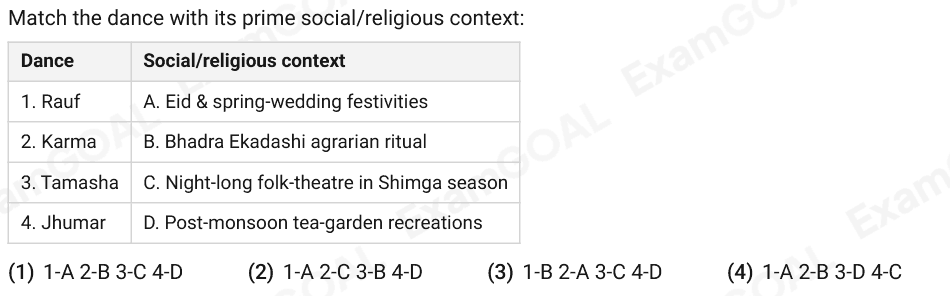
Match the dance with its prime social/religious context: Dance Social/religious context 1. Rauf A. Eid & spring-wedding festivities 2. Karma B. Bhadra Ekadashi agrarian ritual 3. Tamasha C. Night-long folk-theatre in Shimga season 4. Jhumar D. Post-monsoon tea-garden recreations
Answer: A
Which of the following pairs of Kashmiri music and its description is correctly matched?
Answer: C
How many pairs of decorative wheels are found on the Konark Sun Temple chariot?
Answer: C
Which of the following best reflects Kerala's musical instrument heritage?
Answer: D
Who was honoured with the Padma Shri in 2025 for empowering women by teaching traditional Bengali folk percussion?
Answer: A
Consider the statements about Jhora: 1. It is danced in Kumaon by mixed circles of men and women during spring fairs. 2. The dance is accompanied primarily by the Hurka drum. Which is/are correct?
Answer: C
What do the carved wheels on the Konark Sun Temple represent?
Answer: B
What is the name of the festival celebrated simultaneously by unmarried tribal girls during the Karam celebrations in Jharkhand and eastern India?
Answer: A
