229 questions asked across 4 exam years, newest first
Read the following passage and answer the questions based on the passage: India's COVID-19 vaccination campaign, while monumental in scale and intent, was fraught with complex logistical, social, and political challenges. As the world's second-most populous country, India faced the daunting task of inoculating over a billion people amid fluctuating supply chains, vaccine hesitancy, and infrastructural disparities. The initial rollout was hampered by inequitable distribution, with urban centers receiving a disproportionately higher number of doses compared to rural hinterlands. This imbalance stemmed not only from administrative centralization but also from the lack of cold-chain infrastructure in remote regions, where power outages and storage limitations rendered vaccine transport perilous. Simultaneously, vaccine skepticism — fueled by misinformation on social media and cultural misconceptions — undermined public trust. Rumors suggesting adverse effects or population control agendas percolated across digital platforms, particularly in vernacular languages, exacerbating resistance among vulnerable populations. While the introduction of CoWIN, a digital registration platform, was a significant innovation, it inadvertently marginalized large segments of the population unfamiliar with smartphones or digital literacy. The digital divide thus intersected with public health, reinforcing pre- existing socioeconomic inequalities. Despite these obstacles, India managed to recalibrate its strategy. The decentralization of vaccine procurement to states, the engagement of local influencers and religious leaders, and the use of mobile vaccination units gradually improved outreach. Furthermore, indigenous vaccine production — particularly Covishield and Covaxin — allowed India to reduce dependence on global supply chains and even undertake vaccine diplomacy under the "Vaccine Maitri" initiative. The COVID vaccination drive in India stands as a testament to the nation's capacity for mass mobilization under crisis. Yet, it also reveals the critical interplay between public trust, infrastructural resilience, and inclusive policy design — elements essential for future public health interventions in a digitally stratified society.
Which phrase best summarizes the core theme of the passage?
Answer: D
Read the following passage and answer the questions based on the passage: India's COVID-19 vaccination campaign, while monumental in scale and intent, was fraught with complex logistical, social, and political challenges. As the world's second-most populous country, India faced the daunting task of inoculating over a billion people amid fluctuating supply chains, vaccine hesitancy, and infrastructural disparities. The initial rollout was hampered by inequitable distribution, with urban centers receiving a disproportionately higher number of doses compared to rural hinterlands. This imbalance stemmed not only from administrative centralization but also from the lack of cold-chain infrastructure in remote regions, where power outages and storage limitations rendered vaccine transport perilous. Simultaneously, vaccine skepticism — fueled by misinformation on social media and cultural misconceptions — undermined public trust. Rumors suggesting adverse effects or population control agendas percolated across digital platforms, particularly in vernacular languages, exacerbating resistance among vulnerable populations. While the introduction of CoWIN, a digital registration platform, was a significant innovation, it inadvertently marginalized large segments of the population unfamiliar with smartphones or digital literacy. The digital divide thus intersected with public health, reinforcing pre- existing socioeconomic inequalities. Despite these obstacles, India managed to recalibrate its strategy. The decentralization of vaccine procurement to states, the engagement of local influencers and religious leaders, and the use of mobile vaccination units gradually improved outreach. Furthermore, indigenous vaccine production — particularly Covishield and Covaxin — allowed India to reduce dependence on global supply chains and even undertake vaccine diplomacy under the "Vaccine Maitri" initiative. The COVID vaccination drive in India stands as a testament to the nation's capacity for mass mobilization under crisis. Yet, it also reveals the critical interplay between public trust, infrastructural resilience, and inclusive policy design — elements essential for future public health interventions in a digitally stratified society.
What is the author's tone toward India's vaccine campaign?
Answer: B
Read the following passage and answer the questions based on the passage: While education and wisdom are often conflated in colloquial discourse, a discerning mind perceives a fundamental divergence between the two. Education is the formal acquisition of knowledge, often measured through degrees, academic accolades, and proficiency in structured disciplines. It is delivered through systematic curricula, institutionalized assessment, and theoretical frameworks. However, wisdom transcends this rigidity; it is the judicious application of knowledge to real-life contexts, enriched by experience, introspection, and emotional intelligence. An individual may be extensively educated yet remain bereft of wisdom if they lack the discernment to apply their learning ethically and effectively. Conversely, many wise individuals — farmers, artisans, elders — may not possess formal education, but their decisions exhibit prudence and sagacity cultivated through lived realities. Thus, education equips the mind, but wisdom enriches the soul. In an era dominated by information overload and algorithmic thinking, the schism between the two has widened. Educational institutions often prioritize rote memorization and standardized testing over critical thinking and moral reasoning. Consequently, society produces individuals proficient in problem-solving but deficient in decision-making that requires empathy, patience, or foresight. Wisdom, being innately human, cannot be downloaded or fast-tracked; it is earned through trial, failure, reflection, and a nuanced understanding of human nature. Furthermore, while education is temporally bounded — ending with formal schooling or academic milestones — wisdom is a lifelong pursuit. It does not boast certificates but manifests in humility, ethical consistency, and the ability to navigate ambiguity with grace. Ultimately, the highest form of intelligence lies not merely in knowing what is right, but in consistently choosing to do it, especially when it is inconvenient.
According to the passage, how is wisdom primarily acquired?
Answer: C
Read the following passage and answer the questions based on the passage: While education and wisdom are often conflated in colloquial discourse, a discerning mind perceives a fundamental divergence between the two. Education is the formal acquisition of knowledge, often measured through degrees, academic accolades, and proficiency in structured disciplines. It is delivered through systematic curricula, institutionalized assessment, and theoretical frameworks. However, wisdom transcends this rigidity; it is the judicious application of knowledge to real-life contexts, enriched by experience, introspection, and emotional intelligence. An individual may be extensively educated yet remain bereft of wisdom if they lack the discernment to apply their learning ethically and effectively. Conversely, many wise individuals — farmers, artisans, elders — may not possess formal education, but their decisions exhibit prudence and sagacity cultivated through lived realities. Thus, education equips the mind, but wisdom enriches the soul. In an era dominated by information overload and algorithmic thinking, the schism between the two has widened. Educational institutions often prioritize rote memorization and standardized testing over critical thinking and moral reasoning. Consequently, society produces individuals proficient in problem-solving but deficient in decision-making that requires empathy, patience, or foresight. Wisdom, being innately human, cannot be downloaded or fast-tracked; it is earned through trial, failure, reflection, and a nuanced understanding of human nature. Furthermore, while education is temporally bounded — ending with formal schooling or academic milestones — wisdom is a lifelong pursuit. It does not boast certificates but manifests in humility, ethical consistency, and the ability to navigate ambiguity with grace. Ultimately, the highest form of intelligence lies not merely in knowing what is right, but in consistently choosing to do it, especially when it is inconvenient.
What does the author mean by "wisdom enriches the soul"?
Answer: B
Read the following passage and answer the questions based on the passage: While education and wisdom are often conflated in colloquial discourse, a discerning mind perceives a fundamental divergence between the two. Education is the formal acquisition of knowledge, often measured through degrees, academic accolades, and proficiency in structured disciplines. It is delivered through systematic curricula, institutionalized assessment, and theoretical frameworks. However, wisdom transcends this rigidity; it is the judicious application of knowledge to real-life contexts, enriched by experience, introspection, and emotional intelligence. An individual may be extensively educated yet remain bereft of wisdom if they lack the discernment to apply their learning ethically and effectively. Conversely, many wise individuals — farmers, artisans, elders — may not possess formal education, but their decisions exhibit prudence and sagacity cultivated through lived realities. Thus, education equips the mind, but wisdom enriches the soul. In an era dominated by information overload and algorithmic thinking, the schism between the two has widened. Educational institutions often prioritize rote memorization and standardized testing over critical thinking and moral reasoning. Consequently, society produces individuals proficient in problem-solving but deficient in decision-making that requires empathy, patience, or foresight. Wisdom, being innately human, cannot be downloaded or fast-tracked; it is earned through trial, failure, reflection, and a nuanced understanding of human nature. Furthermore, while education is temporally bounded — ending with formal schooling or academic milestones — wisdom is a lifelong pursuit. It does not boast certificates but manifests in humility, ethical consistency, and the ability to navigate ambiguity with grace. Ultimately, the highest form of intelligence lies not merely in knowing what is right, but in consistently choosing to do it, especially when it is inconvenient.
Who, according to the author, can be wise despite lacking formal education?
Answer: C
Read the following passage and answer the questions based on the passage: While education and wisdom are often conflated in colloquial discourse, a discerning mind perceives a fundamental divergence between the two. Education is the formal acquisition of knowledge, often measured through degrees, academic accolades, and proficiency in structured disciplines. It is delivered through systematic curricula, institutionalized assessment, and theoretical frameworks. However, wisdom transcends this rigidity; it is the judicious application of knowledge to real-life contexts, enriched by experience, introspection, and emotional intelligence. An individual may be extensively educated yet remain bereft of wisdom if they lack the discernment to apply their learning ethically and effectively. Conversely, many wise individuals — farmers, artisans, elders — may not possess formal education, but their decisions exhibit prudence and sagacity cultivated through lived realities. Thus, education equips the mind, but wisdom enriches the soul. In an era dominated by information overload and algorithmic thinking, the schism between the two has widened. Educational institutions often prioritize rote memorization and standardized testing over critical thinking and moral reasoning. Consequently, society produces individuals proficient in problem-solving but deficient in decision-making that requires empathy, patience, or foresight. Wisdom, being innately human, cannot be downloaded or fast-tracked; it is earned through trial, failure, reflection, and a nuanced understanding of human nature. Furthermore, while education is temporally bounded — ending with formal schooling or academic milestones — wisdom is a lifelong pursuit. It does not boast certificates but manifests in humility, ethical consistency, and the ability to navigate ambiguity with grace. Ultimately, the highest form of intelligence lies not merely in knowing what is right, but in consistently choosing to do it, especially when it is inconvenient.
What is the central contrast drawn in the passage?
Answer: D
Read the following passage and answer the questions based on the passage: While education and wisdom are often conflated in colloquial discourse, a discerning mind perceives a fundamental divergence between the two. Education is the formal acquisition of knowledge, often measured through degrees, academic accolades, and proficiency in structured disciplines. It is delivered through systematic curricula, institutionalized assessment, and theoretical frameworks. However, wisdom transcends this rigidity; it is the judicious application of knowledge to real-life contexts, enriched by experience, introspection, and emotional intelligence. An individual may be extensively educated yet remain bereft of wisdom if they lack the discernment to apply their learning ethically and effectively. Conversely, many wise individuals — farmers, artisans, elders — may not possess formal education, but their decisions exhibit prudence and sagacity cultivated through lived realities. Thus, education equips the mind, but wisdom enriches the soul. In an era dominated by information overload and algorithmic thinking, the schism between the two has widened. Educational institutions often prioritize rote memorization and standardized testing over critical thinking and moral reasoning. Consequently, society produces individuals proficient in problem-solving but deficient in decision-making that requires empathy, patience, or foresight. Wisdom, being innately human, cannot be downloaded or fast-tracked; it is earned through trial, failure, reflection, and a nuanced understanding of human nature. Furthermore, while education is temporally bounded — ending with formal schooling or academic milestones — wisdom is a lifelong pursuit. It does not boast certificates but manifests in humility, ethical consistency, and the ability to navigate ambiguity with grace. Ultimately, the highest form of intelligence lies not merely in knowing what is right, but in consistently choosing to do it, especially when it is inconvenient.
According to the author, why has the gap between education and wisdom widened in recent times?
Answer: C
Rearrange the following sentences in correct order to make a logical passage: 1. A media strategy was framed based on outreach results. 2. Demographic metrics were tracked from campaign dashboards. 3. User interactions were collected across platforms. 4. Analysts segmented users by age and behavior.
Answer: A
Read the following passage and answer the questions based on the passage: The proliferation of social media has fundamentally transformed the democratic landscape, acting both as a catalyst for civic engagement and a conduit for manipulation. Platforms like Twitter, Facebook, and Instagram, once relegated to the domain of personal expression, now serve as powerful instruments of political discourse, enabling citizens to articulate opinions, mobilize for causes, and scrutinize authority in real-time. At its core, democracy thrives on the free flow of information, and social media ostensibly democratizes this process by dismantling traditional gatekeeping. Political leaders communicate directly with constituents, bypassing editorial filters, while grassroots movements harness virality to amplify marginalized voices. During critical events—be it elections, protests, or legislative debates—social media acts as a digital agora, fostering participatory dialogue that was once confined to town halls or print columns. However, this unprecedented openness is double-edged. The same platforms that disseminate truth can also propagate misinformation, polarize public opinion, and algorithmically reinforce ideological silos. Electoral interference through fake accounts, coordinated trolling, and the spread of disinformation campaigns have threatened electoral integrity in several democracies. Moreover, emotionally charged content, optimized for engagement rather than accuracy, often eclipses nuanced debate, reducing political discourse to a cacophony of outrage. The role of social media in democracy, therefore, is contingent not just on its technological architecture, but on the ethical frameworks governing its use. Regulatory oversight, media literacy, and algorithmic transparency are essential to harness its democratic potential while mitigating its subversive tendencies. In essence, social media is neither inherently virtuous nor inherently corrosive—it is a mirror of societal intent. Whether it becomes a pillar of democratic resilience or a tool of populist distortion depends largely on how it is wielded by citizens, institutions, and platforms alike.
What primary democratic function does social media serve, as per the paragraph?
Answer: C
Read the following passage and answer the questions based on the passage: The proliferation of social media has fundamentally transformed the democratic landscape, acting both as a catalyst for civic engagement and a conduit for manipulation. Platforms like Twitter, Facebook, and Instagram, once relegated to the domain of personal expression, now serve as powerful instruments of political discourse, enabling citizens to articulate opinions, mobilize for causes, and scrutinize authority in real-time. At its core, democracy thrives on the free flow of information, and social media ostensibly democratizes this process by dismantling traditional gatekeeping. Political leaders communicate directly with constituents, bypassing editorial filters, while grassroots movements harness virality to amplify marginalized voices. During critical events—be it elections, protests, or legislative debates—social media acts as a digital agora, fostering participatory dialogue that was once confined to town halls or print columns. However, this unprecedented openness is double-edged. The same platforms that disseminate truth can also propagate misinformation, polarize public opinion, and algorithmically reinforce ideological silos. Electoral interference through fake accounts, coordinated trolling, and the spread of disinformation campaigns have threatened electoral integrity in several democracies. Moreover, emotionally charged content, optimized for engagement rather than accuracy, often eclipses nuanced debate, reducing political discourse to a cacophony of outrage. The role of social media in democracy, therefore, is contingent not just on its technological architecture, but on the ethical frameworks governing its use. Regulatory oversight, media literacy, and algorithmic transparency are essential to harness its democratic potential while mitigating its subversive tendencies. In essence, social media is neither inherently virtuous nor inherently corrosive—it is a mirror of societal intent. Whether it becomes a pillar of democratic resilience or a tool of populist distortion depends largely on how it is wielded by citizens, institutions, and platforms alike.
What makes social media a double-edged tool in democratic societies?
Answer: C
Read the following passage and answer the questions based on the passage: The proliferation of social media has fundamentally transformed the democratic landscape, acting both as a catalyst for civic engagement and a conduit for manipulation. Platforms like Twitter, Facebook, and Instagram, once relegated to the domain of personal expression, now serve as powerful instruments of political discourse, enabling citizens to articulate opinions, mobilize for causes, and scrutinize authority in real-time. At its core, democracy thrives on the free flow of information, and social media ostensibly democratizes this process by dismantling traditional gatekeeping. Political leaders communicate directly with constituents, bypassing editorial filters, while grassroots movements harness virality to amplify marginalized voices. During critical events—be it elections, protests, or legislative debates—social media acts as a digital agora, fostering participatory dialogue that was once confined to town halls or print columns. However, this unprecedented openness is double-edged. The same platforms that disseminate truth can also propagate misinformation, polarize public opinion, and algorithmically reinforce ideological silos. Electoral interference through fake accounts, coordinated trolling, and the spread of disinformation campaigns have threatened electoral integrity in several democracies. Moreover, emotionally charged content, optimized for engagement rather than accuracy, often eclipses nuanced debate, reducing political discourse to a cacophony of outrage. The role of social media in democracy, therefore, is contingent not just on its technological architecture, but on the ethical frameworks governing its use. Regulatory oversight, media literacy, and algorithmic transparency are essential to harness its democratic potential while mitigating its subversive tendencies. In essence, social media is neither inherently virtuous nor inherently corrosive—it is a mirror of societal intent. Whether it becomes a pillar of democratic resilience or a tool of populist distortion depends largely on how it is wielded by citizens, institutions, and platforms alike.
According to the paragraph, which element amplifies marginalized voices through social media?
Answer: C
Read the following passage and answer the questions based on the passage: The proliferation of social media has fundamentally transformed the democratic landscape, acting both as a catalyst for civic engagement and a conduit for manipulation. Platforms like Twitter, Facebook, and Instagram, once relegated to the domain of personal expression, now serve as powerful instruments of political discourse, enabling citizens to articulate opinions, mobilize for causes, and scrutinize authority in real-time. At its core, democracy thrives on the free flow of information, and social media ostensibly democratizes this process by dismantling traditional gatekeeping. Political leaders communicate directly with constituents, bypassing editorial filters, while grassroots movements harness virality to amplify marginalized voices. During critical events—be it elections, protests, or legislative debates—social media acts as a digital agora, fostering participatory dialogue that was once confined to town halls or print columns. However, this unprecedented openness is double-edged. The same platforms that disseminate truth can also propagate misinformation, polarize public opinion, and algorithmically reinforce ideological silos. Electoral interference through fake accounts, coordinated trolling, and the spread of disinformation campaigns have threatened electoral integrity in several democracies. Moreover, emotionally charged content, optimized for engagement rather than accuracy, often eclipses nuanced debate, reducing political discourse to a cacophony of outrage. The role of social media in democracy, therefore, is contingent not just on its technological architecture, but on the ethical frameworks governing its use. Regulatory oversight, media literacy, and algorithmic transparency are essential to harness its democratic potential while mitigating its subversive tendencies. In essence, social media is neither inherently virtuous nor inherently corrosive—it is a mirror of societal intent. Whether it becomes a pillar of democratic resilience or a tool of populist distortion depends largely on how it is wielded by citizens, institutions, and platforms alike.
What does the author suggest as a critical solution to social media misuse in democracies?
Answer: C
Read the following passage and answer the questions based on the passage: The proliferation of social media has fundamentally transformed the democratic landscape, acting both as a catalyst for civic engagement and a conduit for manipulation. Platforms like Twitter, Facebook, and Instagram, once relegated to the domain of personal expression, now serve as powerful instruments of political discourse, enabling citizens to articulate opinions, mobilize for causes, and scrutinize authority in real-time. At its core, democracy thrives on the free flow of information, and social media ostensibly democratizes this process by dismantling traditional gatekeeping. Political leaders communicate directly with constituents, bypassing editorial filters, while grassroots movements harness virality to amplify marginalized voices. During critical events—be it elections, protests, or legislative debates—social media acts as a digital agora, fostering participatory dialogue that was once confined to town halls or print columns. However, this unprecedented openness is double-edged. The same platforms that disseminate truth can also propagate misinformation, polarize public opinion, and algorithmically reinforce ideological silos. Electoral interference through fake accounts, coordinated trolling, and the spread of disinformation campaigns have threatened electoral integrity in several democracies. Moreover, emotionally charged content, optimized for engagement rather than accuracy, often eclipses nuanced debate, reducing political discourse to a cacophony of outrage. The role of social media in democracy, therefore, is contingent not just on its technological architecture, but on the ethical frameworks governing its use. Regulatory oversight, media literacy, and algorithmic transparency are essential to harness its democratic potential while mitigating its subversive tendencies. In essence, social media is neither inherently virtuous nor inherently corrosive—it is a mirror of societal intent. Whether it becomes a pillar of democratic resilience or a tool of populist distortion depends largely on how it is wielded by citizens, institutions, and platforms alike.
In the author's view, what determines whether social media supports or undermines democracy?
Answer: C
Read the following passage and answer the questions based on the passage: Group thinking, often referred to as groupthink, is a psychological phenomenon wherein the desire for unanimity within a group overrides the motivation to appraise alternative viewpoints critically. It frequently leads to flawed decision-making because dissent is either internally suppressed or socially penalized. Social conformity, its close ally, describes the act of aligning one's beliefs or behaviours with those of a majority, often subconsciously, in pursuit of acceptance or avoidance of conflict. In tightly knit groups— such as corporate boards, political committees, or academic panels—individual members may refrain from expressing contrarian ideas, fearing ostracization or reputational risk. Over time, this collective homogeneity breeds intellectual stagnation, reducing innovation and enhancing vulnerability to strategic errors. The infamous Bay of Pigs invasion and the Challenger space shuttle disaster are frequently cited as textbook examples of decisions marred by groupthink. Psychologically, the roots of group conformity lie in our evolutionary inclination toward tribal belonging, where deviation was historically associated with survival risk. In modern society, the same instinct manifests through peer pressure, organizational culture, and digital echo chambers. Algorithms reinforce conformity by curating information bubbles that validate existing biases while filtering out divergent thought. However, the remedy to such cognitive myopia lies in institutionalizing dissent. Constructive disagreement, when encouraged within teams or communities, acts as an intellectual safeguard against tunnel vision. Promoting a culture where counterarguments are respected rather than reprimanded can lead to more robust, balanced, and resilient decision-making. In an age dominated by viral trends, polarized discourse, and performative alignment, the courage to question consensus is both rare and essential. True progress emerges not from blind allegiance to majority norms, but from critical inquiry and the audacity to challenge the comfortable.
What is the central idea of groupthink as discussed in the passage?
Answer: B
Read the following passage and answer the questions based on the passage: Group thinking, often referred to as groupthink, is a psychological phenomenon wherein the desire for unanimity within a group overrides the motivation to appraise alternative viewpoints critically. It frequently leads to flawed decision-making because dissent is either internally suppressed or socially penalized. Social conformity, its close ally, describes the act of aligning one's beliefs or behaviours with those of a majority, often subconsciously, in pursuit of acceptance or avoidance of conflict. In tightly knit groups— such as corporate boards, political committees, or academic panels—individual members may refrain from expressing contrarian ideas, fearing ostracization or reputational risk. Over time, this collective homogeneity breeds intellectual stagnation, reducing innovation and enhancing vulnerability to strategic errors. The infamous Bay of Pigs invasion and the Challenger space shuttle disaster are frequently cited as textbook examples of decisions marred by groupthink. Psychologically, the roots of group conformity lie in our evolutionary inclination toward tribal belonging, where deviation was historically associated with survival risk. In modern society, the same instinct manifests through peer pressure, organizational culture, and digital echo chambers. Algorithms reinforce conformity by curating information bubbles that validate existing biases while filtering out divergent thought. However, the remedy to such cognitive myopia lies in institutionalizing dissent. Constructive disagreement, when encouraged within teams or communities, acts as an intellectual safeguard against tunnel vision. Promoting a culture where counterarguments are respected rather than reprimanded can lead to more robust, balanced, and resilient decision-making. In an age dominated by viral trends, polarized discourse, and performative alignment, the courage to question consensus is both rare and essential. True progress emerges not from blind allegiance to majority norms, but from critical inquiry and the audacity to challenge the comfortable.
According to the passage, what evolutionary trait contributes to social conformity?
Answer: C
Read the following passage and answer the questions based on the passage: Group thinking, often referred to as groupthink, is a psychological phenomenon wherein the desire for unanimity within a group overrides the motivation to appraise alternative viewpoints critically. It frequently leads to flawed decision-making because dissent is either internally suppressed or socially penalized. Social conformity, its close ally, describes the act of aligning one's beliefs or behaviours with those of a majority, often subconsciously, in pursuit of acceptance or avoidance of conflict. In tightly knit groups— such as corporate boards, political committees, or academic panels—individual members may refrain from expressing contrarian ideas, fearing ostracization or reputational risk. Over time, this collective homogeneity breeds intellectual stagnation, reducing innovation and enhancing vulnerability to strategic errors. The infamous Bay of Pigs invasion and the Challenger space shuttle disaster are frequently cited as textbook examples of decisions marred by groupthink. Psychologically, the roots of group conformity lie in our evolutionary inclination toward tribal belonging, where deviation was historically associated with survival risk. In modern society, the same instinct manifests through peer pressure, organizational culture, and digital echo chambers. Algorithms reinforce conformity by curating information bubbles that validate existing biases while filtering out divergent thought. However, the remedy to such cognitive myopia lies in institutionalizing dissent. Constructive disagreement, when encouraged within teams or communities, acts as an intellectual safeguard against tunnel vision. Promoting a culture where counterarguments are respected rather than reprimanded can lead to more robust, balanced, and resilient decision-making. In an age dominated by viral trends, polarized discourse, and performative alignment, the courage to question consensus is both rare and essential. True progress emerges not from blind allegiance to majority norms, but from critical inquiry and the audacity to challenge the comfortable.
Which event is cited as a real-world consequence of groupthink?
Answer: B
Read the following passage and answer the questions based on the passage: Group thinking, often referred to as groupthink, is a psychological phenomenon wherein the desire for unanimity within a group overrides the motivation to appraise alternative viewpoints critically. It frequently leads to flawed decision-making because dissent is either internally suppressed or socially penalized. Social conformity, its close ally, describes the act of aligning one's beliefs or behaviours with those of a majority, often subconsciously, in pursuit of acceptance or avoidance of conflict. In tightly knit groups— such as corporate boards, political committees, or academic panels—individual members may refrain from expressing contrarian ideas, fearing ostracization or reputational risk. Over time, this collective homogeneity breeds intellectual stagnation, reducing innovation and enhancing vulnerability to strategic errors. The infamous Bay of Pigs invasion and the Challenger space shuttle disaster are frequently cited as textbook examples of decisions marred by groupthink. Psychologically, the roots of group conformity lie in our evolutionary inclination toward tribal belonging, where deviation was historically associated with survival risk. In modern society, the same instinct manifests through peer pressure, organizational culture, and digital echo chambers. Algorithms reinforce conformity by curating information bubbles that validate existing biases while filtering out divergent thought. However, the remedy to such cognitive myopia lies in institutionalizing dissent. Constructive disagreement, when encouraged within teams or communities, acts as an intellectual safeguard against tunnel vision. Promoting a culture where counterarguments are respected rather than reprimanded can lead to more robust, balanced, and resilient decision-making. In an age dominated by viral trends, polarized discourse, and performative alignment, the courage to question consensus is both rare and essential. True progress emerges not from blind allegiance to majority norms, but from critical inquiry and the audacity to challenge the comfortable.
How does digital media reinforce conformity, according to the passage?
Answer: C
Read the following passage and answer the questions based on the passage: Group thinking, often referred to as groupthink, is a psychological phenomenon wherein the desire for unanimity within a group overrides the motivation to appraise alternative viewpoints critically. It frequently leads to flawed decision-making because dissent is either internally suppressed or socially penalized. Social conformity, its close ally, describes the act of aligning one's beliefs or behaviours with those of a majority, often subconsciously, in pursuit of acceptance or avoidance of conflict. In tightly knit groups— such as corporate boards, political committees, or academic panels—individual members may refrain from expressing contrarian ideas, fearing ostracization or reputational risk. Over time, this collective homogeneity breeds intellectual stagnation, reducing innovation and enhancing vulnerability to strategic errors. The infamous Bay of Pigs invasion and the Challenger space shuttle disaster are frequently cited as textbook examples of decisions marred by groupthink. Psychologically, the roots of group conformity lie in our evolutionary inclination toward tribal belonging, where deviation was historically associated with survival risk. In modern society, the same instinct manifests through peer pressure, organizational culture, and digital echo chambers. Algorithms reinforce conformity by curating information bubbles that validate existing biases while filtering out divergent thought. However, the remedy to such cognitive myopia lies in institutionalizing dissent. Constructive disagreement, when encouraged within teams or communities, acts as an intellectual safeguard against tunnel vision. Promoting a culture where counterarguments are respected rather than reprimanded can lead to more robust, balanced, and resilient decision-making. In an age dominated by viral trends, polarized discourse, and performative alignment, the courage to question consensus is both rare and essential. True progress emerges not from blind allegiance to majority norms, but from critical inquiry and the audacity to challenge the comfortable.
What is suggested as a solution to groupthink and conformity?
Answer: C
Rearrange the following sentences in correct order to make a logical passage: 1. The team analyzed the survey data. 2. Insights were used to improve the customer experience. 3. A targeted marketing campaign was created. 4. The data was collected through various channels.
Answer: D
In the following passage, some words have been deleted. Read the passage carefully and select the most appropriate option to fill in each blank. 2022 sees us entering a third year of the pandemic, and the harm 1________ children is increasingly evident: A record rise in child poverty. Setbacks to progress on 2_________ vaccinations. Disruption to education for entire generation. That harm 3________ as an unintended side effect of the world's efforts to manage the crisis. COVID has been a uniquely dis-equalizing crisis. Lopsided 4________ vaccines aside, learning losses have been greatest among poorest children, and job losses have been disproportionately borne by women and youth. What next for the world’s children in the year ahead? As in the past two years, prospects for children will continue to hinge 5________ on the pandemic and how it is managed. Select the most appropriate option to fill in blank No. 1.
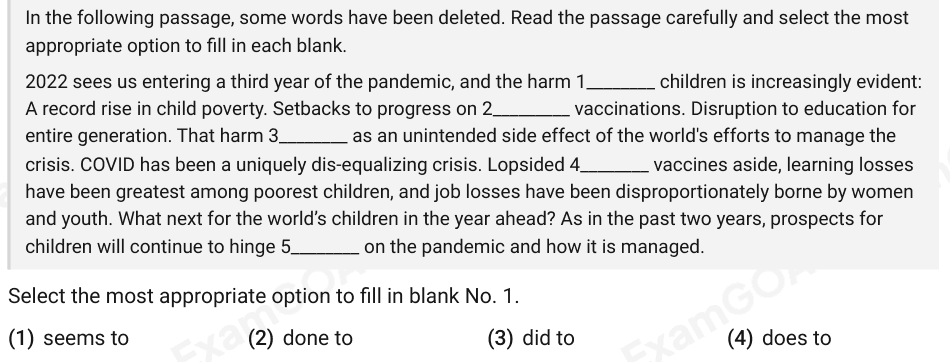
Answer: B
In the following passage, some words have been deleted. Read the passage carefully and select the most appropriate option to fill in each blank. Social media companies (1)______ claim that they promote democracy and are dedicated to the empowerment of ordinary individuals. The assertion (2)______ entirely unfounded. Recent history shows how (3)______ citizens have been mobilised against totalitarian regimes on social networking sites. Starting from MeToo to Black Lives Matter, digital networks (4)______ indispensable in bringing together critical voices against social and political (5)______ . Select the most appropriate option to fill in blank no. 1
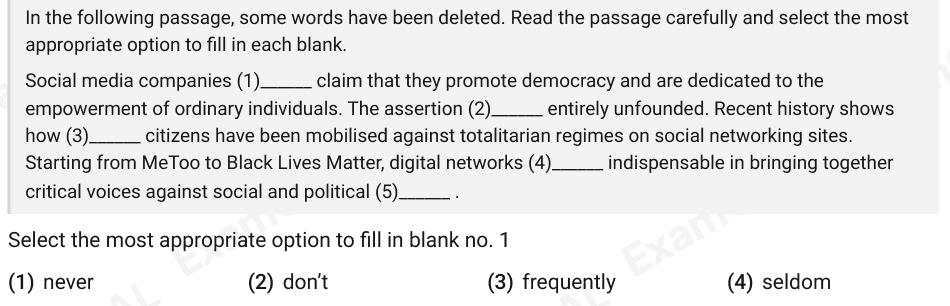
Answer: C
In the following passage, some words have been deleted. Read the passage carefully and select the most appropriate option to fill in each blank. The mathematician Federico Ardila-Mantilla grew up in Colombia, an (1) ______________ student but gifted in math. He was failing most of his classes at his high school in Bogotá when someone (2) _______________ him to apply to MIT. He had not heard of the school. To his surprise, he got in, and he went on scholarship. Mathematically, he did well. One of his professors, an acid-tongued theoretician known to (3) ____________ his audience to a herd of cows, routinely tucked ‘open’ math problems into homework assignments, without telling the students. These had never been solved by anyone. Ardila solved one. He went on to receive his bachelor’s and Ph.D. in math from MIT. But his academic experience was also one of isolation. Part of it had to do with his own (4) _____________. Part of it was cultural. As a Latino, he was very much in the minority in the department, and he did not feel comfortable in American mathematical spaces. No one had tried to explicitly (5) ______________ him, yet he felt alone. In math, collaborating with others opens up new kinds of learning and thinking. But in his nine years at MIT, Ardila worked with others only twice. Select the most appropriate option to fill in blank no. 1.
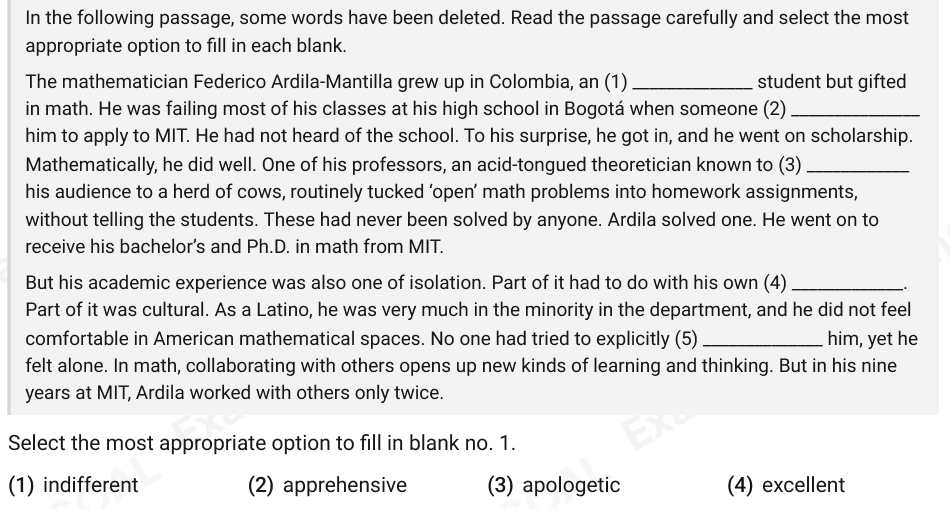
Answer: A
Select the word which means the same as the group of words given. Essence or main point of any passage, lecture or book.
Answer: B
In the following passage, some words have been deleted. Read the passage carefully and select the most appropriate option to fill in each blank. When Ojeya Cruz Banks moved to Ohio from New Zealand (1) ________ years ago, she was overwhelmed by the logistics of uprooting her life. But Cruz Banks, a Denison University professor and a single mom, who is also my neighbour and friend, was (2) ________ to find a house next to a public elementary school. She assumed that she would be able to walk to pick up her daughter, a needed convenience given that she didn’t yet have a car. Unfortunately, when she went to register her daughter for kindergarten, she was met with an (3) ________ surprise: The only (4) ________ option was a half-day program that would bus students to a day-care centre on the outskirts of the town for the afternoon. The district did offer a limited number of full-day slots, but those had all been claimed in a lottery earlier that spring and came with a tuition cost. “I was like, ‘Cost me? What? Public school costs money here?’” she told me. Many parents across the United States, like Cruz Banks, may assume that free, full-day kindergarten is a (5) ________ part of the country’s public education system. I was one of them, until my youngest had to enter our district’s lottery several months ago. When he was assigned to the half-day program, I swung between alarm and frustration. Select the most appropriate option to fill in blank no. 1.
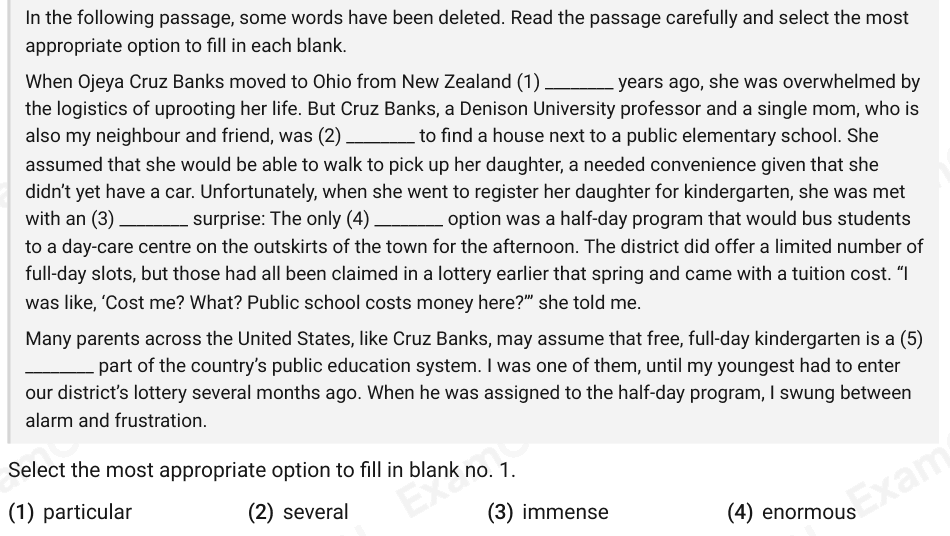
Answer: B
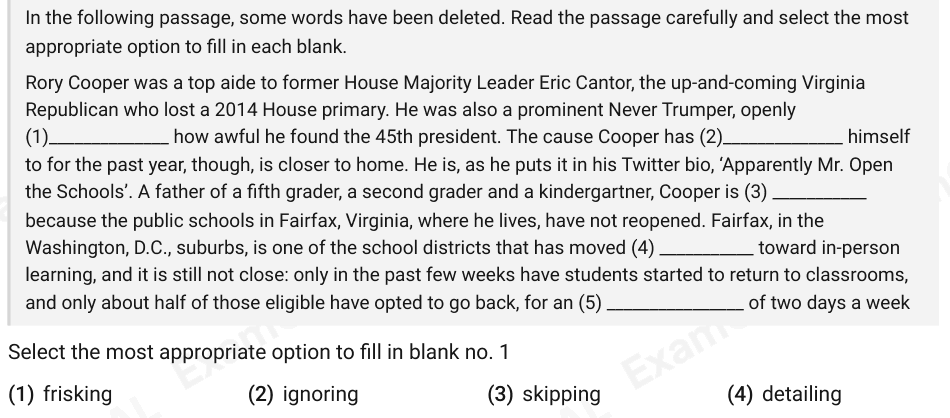
In the following passage, some words have been deleted. Read the passage carefully and select the most appropriate option to fill in each blank. Rory Cooper was a top aide to former House Majority Leader Eric Cantor, the up-and-coming Virginia Republican who lost a 2014 House primary. He was also a prominent Never Trumper, openly
Answer: D
