433 questions asked across 18 exam years, newest first
Consider the following statements 1. A = (A ∪ B) ∪ (A - B), 2. A ∪ (B - A) = (A ∪ B) 3. B = (A ∪ B) - (A - B) Which of the statements given above are correct?
Answer: B
A function satisfies , where . If , then what is equal to ?
Answer: D
Consider the following for the next items that follow: Let a function f be defined on and . What is f(0.5) equal to ?
Answer: B
Consider the following for the next items that follow: A function is defined by . What is the range of the function?
Answer: B
Consider the following for the next items that follow: A function is defined by . What is the period of the function?
Answer: B
Consider the following for the next items that follow: Let . What is the domain of the function?
Answer: B
Consider the following for the next items that follow: Let . What is the greatest value of the function?
Answer: C
Consider the following for the next items that follow: Let and , where [.] is the greatest integer function. Let . What is equal to ?
Answer: B
Consider the following for the next items that follow: Let and , where [.] is the greatest integer function. Let . What is equal to ?
Answer: A
What is the range of the function f(x) = x + |x| if the domain is the set of real numbers ?
Answer: B
If , then what is equal to ?
Answer: A
The central angles p, q, r and s (in degrees) of four sectors in a Pie Chart satisfy the relation 9p = 3q = 2r = 6s. What is the value of 4p - q ?
Answer: D
Consider the following statements : 1. If f is the subset of Z × Z defined by f = {(xy, x − y); x, y ∈ Z}, then f is a function from Z to Z. 2. If f is the subset of N × N defined by f = {(xy, x + y); x, y ∈ N}, then f is a function from N to N. Which of the statements given above is/are correct?
Answer: D
Consider the following statements : 1. The set of all irrational numbers between and is an infinite set. 2. The set of all odd integers less than 100 is a finite set. Which of the statements given above is/are correct?
Answer: A
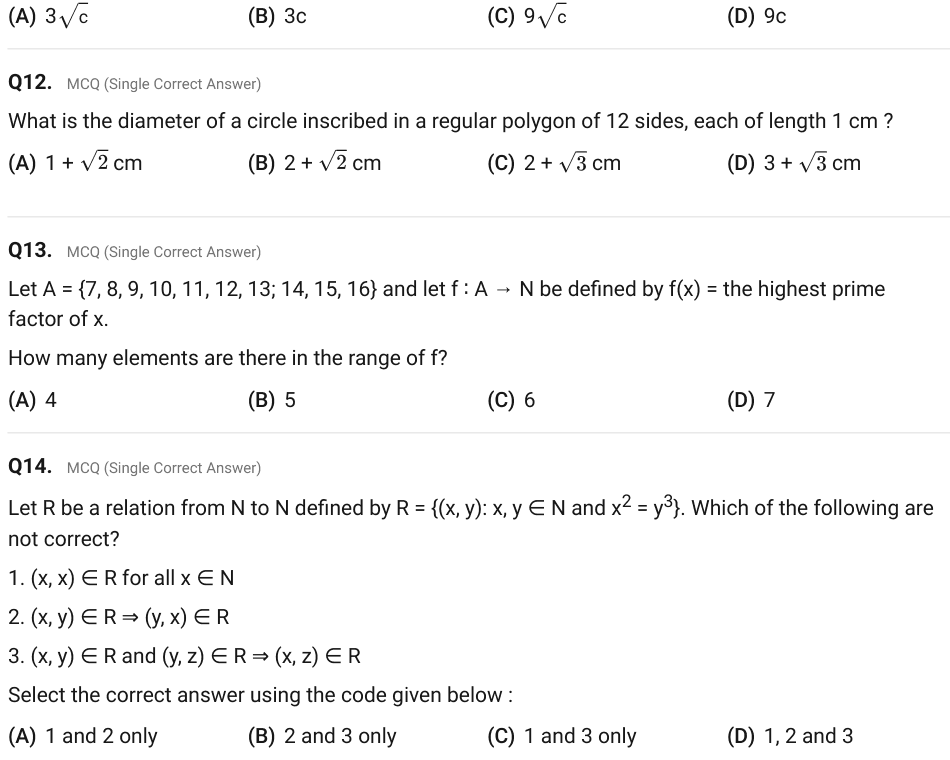
Let A = {7, 8, 9, 10, 11, 12, 13; 14, 15, 16} and let f ∶ A → N be defined by f(x) = the highest prime factor of x. How many elements are there in the range of f?
Answer: C
Answer: D
Consider the following : 1. A ∩ B = A ∩ C ⇒ B = C 2. A ∪ B = A ∪ C ⇒ B = C Which of the above is/are correct ?
Answer: D
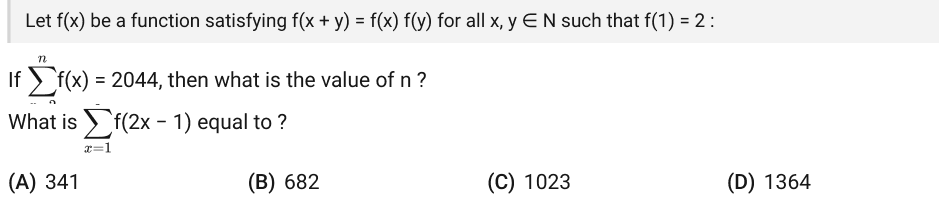
Let be a function satisfying for all such that : If , then what is the value of ?
Answer: C
Answer: B
Let be a function satisfying for all such that : If , then what is the value of ? What is equal to ?
Answer: D
A university awarded medals in basketball, football, and volleyball. Only x students (x < 6) got medal in all the three sports and the medals went to a total of 15x students. It awarded 5x medals in basketball, (4x + 15) medals in football and (x + 25) medals in volleyball.
How many received medals in exactly two of the three sports ?
Answer: C
A university awarded medals in basketball, football, and volleyball. Only x students (x < 6) got medal in all the three sports and the medals went to a total of 15x students. It awarded 5x medals in basketball, (4x + 15) medals in football and (x + 25) medals in volleyball.
How many received medals in at least two of three sports ?
Answer: D
A university awarded medals in basketball, football, and volleyball. Only x students (x < 6) got medal in all the three sports and the medals went to a total of 15x students. It awarded 5x medals in basketball, (4x + 15) medals in football and (x + 25) medals in volleyball.
How many received medals in exactly one of three sports ?
Answer: A
Let z = [y] and y = [x] − x, where [.] is the greatest integer function. If x is not an integer but positive, then what is the value of z ?
Answer: A
If f(x) = 4x + 1 and g(x) = kx + 2 such that fog(x) = gof(x), then what is the value of k ?
Answer: A
