127 questions asked across 18 exam years, newest first
If where , then the argument of is
Answer: D
If are the cube roots of unity, then the value of is
Answer: C
What is the square root of , where ?
Answer: C
can be factorised as where is one of the cube roots of unity.
Answer: B
What is where , equal to?
Answer: C
What is the real part of where ?
Answer: B
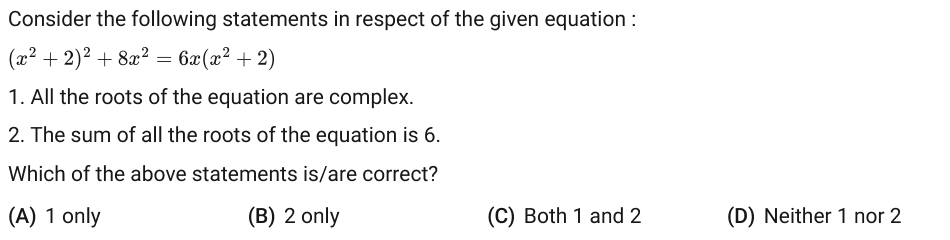
Consider the following statements in respect of the given equation : 1. All the roots of the equation are complex. 2. The sum of all the roots of the equation is 6. Which of the above statements is/are correct?
Answer: B
Let z be a complex number such that and . What is z equal to ? where
Answer: C
If and are two complex numbers, then the modulus of the quotient of and is:
Answer: D
What is the argument of the complex number where ?
Answer: D
The roots of the equation when and are:
Answer: C
For the next three (03) items that follow: Given that and . What is equal to?
Answer: D
For the next three (03) items that follow: Given that and . What is equal to?
Answer: C
For the next three (03) items that follow: Given that and . What is equal to?
Answer: B
Out of 7 consonants and 4 vowels, words are to be formed by involving 3 consonants and 2 vowels. The number of such words formed is:
Answer: A
How many different words can be formed by taking four letters out of the letters of the word ‘AGAIN’ if each word has to start with A?
Answer: C
The roots of the equation

Answer: C
What is equal to?
Answer: C
What is equal to?
Answer: D
What is the argument of the complex number where ?
Answer: D
If , then the values of x are
Answer: A
A bag contains balls of two colours, 3 black and 3 white. What is the smallest number of balls which must be drawn from the bag, without looking, so that among these there are two of the same colour ?
Answer: B
has
Answer: B
What is the modulus of where ?
Answer: C
What is the number of diagonals which can be drawn by joining the angular points of a polygon of 100 sides?
Answer: A
