132 questions asked across 20 exam years, newest first
An ideal gas is enclosed in a cylinder at pressure of 2 atm and temperature 300 K. The mean time between two successive collisions is . If the pressure is doubled and temperature is increased to 500 K, the mean time between two successive collisions will be close to
Answer: B
Answer: C
A body of mass m starts moving from rest along x-axis so that its velocity varies as where a is a constant and s is the distance covered by the body. The total work done by all the forces acting on the body in the first t seconds after the start of the motion is :
Answer: A
An oscillator of mass M is at rest in its equilibrium position in a potential . A particle of mass m comes from right with speed u and collides completely inelastically with M and sticks to it. This process repeats every time the oscillator crosses its equilibrium position. The amplitude of oscillations after 13 collisions is : (M = 10, m = 5, u = 1, k = 1)
Answer: A
In a collinear collision, a particle with an initial speed strikes a stationary particle of the same mass. If the final total kinetic energy is 50% greater than the original kinetic energy, the magnitude of the relative velocity between the two particles, after collision, is :
Answer: C
N moles of a diatomic gas in a cylinder are at a temperature T. Heat is supplied to the cylinder such that the temperature remains constant but n moles of the diatomic gas get converted into monoatomic gas. What is the change in the total kinetic energy of the gas ?
Answer: A
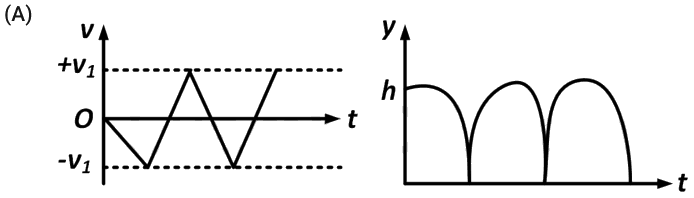
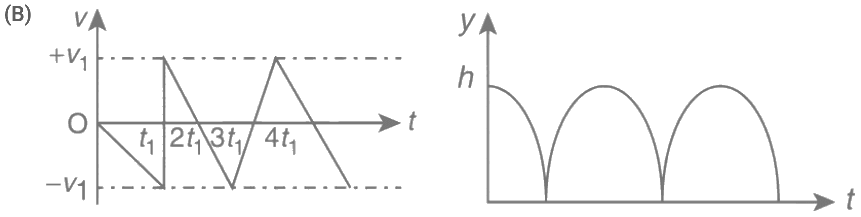
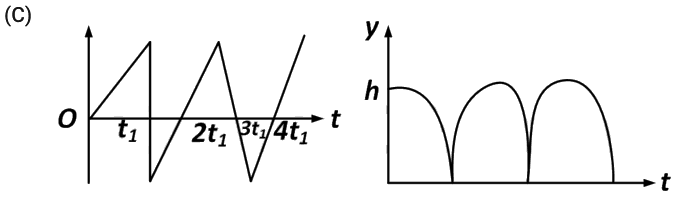
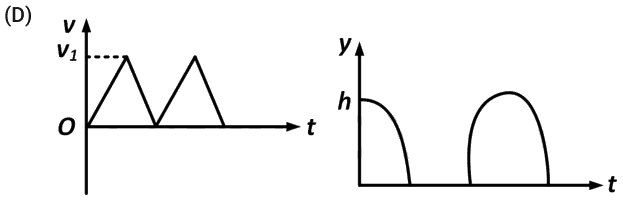
An object is dropped from a height h from the ground. Every time it hits the ground it loses 50% of its kinetic energy. The total distance covered as is :
Answer: A
A person trying to lose weight by burning fat lifts a mass of upto a height of 1000 times. Assume that the potential energy lost each time he lowers the mass is dissipated. How much fat will he use up considering the work done only when the weight is lifted up? Fat supplies of energy per which is converted to mechanical energy with a efficiency rate. Take :
Answer: B
A particle of mass moving in the direction with speed is hit by another particle of mass moving in the direction with speed . If the collision is perfectly inelastic, the percentage loss in the energy during the collision is close to:
Answer: A
When a rubber-band is stretched by a distance , it exerts restoring force of magnitude where and are constants. The work done in stretching the unstretched rubber-band by is :
Answer: C
Two bodies and of mass and respectively are placed on a smooth floor. They are connected by a spring of negligible mass. A third body of mass is placed on the floor. The body moves with a velocity along the line joining and and collides elastically with . At a certain time after the collision it is found that the instantaneous velocities of and are same and the compression of the spring is . The spring constant will be
Answer: D
A particle gets displaced by under the action of a force . The change in its kinetic energy is
Answer: A
The potential energy function for the force between two atoms in a diatomic molecule is approximately given by , where and are constants and is the distance between the atoms. If the dissociation energy of the molecule is , is
Answer: C
Statement - 1 : Two particles moving in the same direction do not lose all their energy in a completely inelastic collision. Statement - 2 : Principle of conservation of momentum holds true for all kinds of collisions.
Answer: A
Answer: B
Answer: A
Answer: A
Two points and are maintained at the potentials of and , respectively. The work done in moving 100 electrons from to is :
Answer: C
The surface of a metal is illuminated with the light of . The kinetic energy of the ejected photoelectrons was found to be . The work function of the metal is : ()
Answer: A

Answer: B
The potential energy of a particle free to move along the -axis is given by . The total mechanical energy of the particle is . Then, the maximum speed (in ) is
Answer: A
A bomb of mass at rest explodes into two pieces of masses and . The velocity of the mass is . The kinetic energy of the other mass is
Answer: B
A body of mass is accelerated uniformly from rest to a speed in a time . The instantaneous power delivered to the body as a function of time is given by
Answer: B
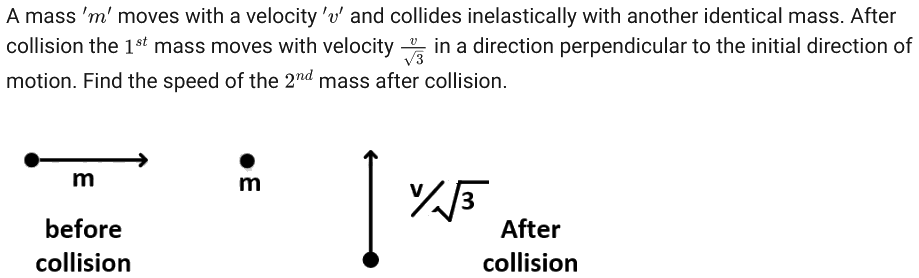
Answer: D
A uniform chain of length is kept on a table such that a length of hangs freely from the edge of the table. The total mass of the chain is . What is the work done in pulling the entire chain on the table?
Answer: B
