115 questions asked across 17 exam years, newest first
Unpolarised light of intensity passes through the combination of three polaroids such that the pass axis of the last polaroid is perpendicular to that of the pass axis of first polaroid. If intensity of emerging light is , then the angle between pass axis of first two polaroids is _________.
Answer: 30 or 60
The ratio of intensities at two points P and Q on the screen in a Young's double slit experiment where phase difference between two waves of same amplitude are and , respectively are
Answer: D
The width of fringe is on the screen in a double slits experiment for the light of wavelength of . The width of the fringe for the light of wavelength will be:
Answer: D
A beam of light consisting of two wavelengths and is used to obtain interference pattern in Young's double slit experiment. The distance between the slits is and the distance between the plane of slits and the screen is . The least distance from the central fringe, where the bright fringes due to both the wavelengths coincide, is . The value of is ___________.
Answer: 462
'' polarizing sheets are arranged such that each makes an angle with the preceding sheet. An unpolarized light of intensity I is incident into this arrangement. The output intensity is found to be . The value of will be:
Answer: D
Two polaroids and are placed in such a way that the pass-axis of polaroids are perpendicular to each other. Now, another polaroid is placed between and bisecting angle between them. If intensity of unpolarized light is then intensity of transmitted light after passing through polaroid will be:
Answer: B
Given below are two statements : One is labelled as Assertion A and the other is labelled as Reason R Assertion A : The beam of electrons show wave nature and exhibit interference and diffraction. Reason R : Davisson Germer Experimentally verified the wave nature of electrons. In the light of the above statements, choose the most appropriate answer from the options given below :
Answer: B
Two light waves of wavelengths and are used in Young's double slit experiment to obtain interference fringes on a screen placed away from plane of slits. If the two slits are separated by , then shortest distance from the central bright maximum to the point where the bright fringes of the two wavelength coincide will be ___________ mm.
Answer: 48
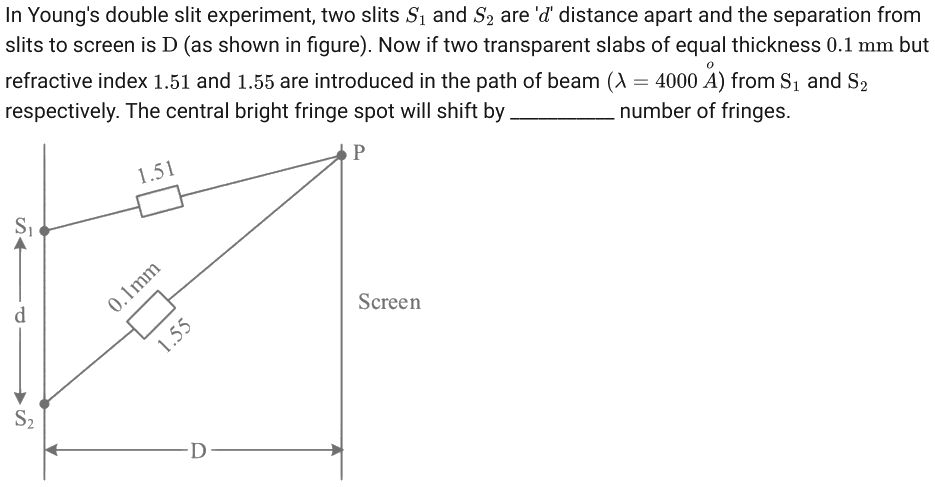
Answer: 10
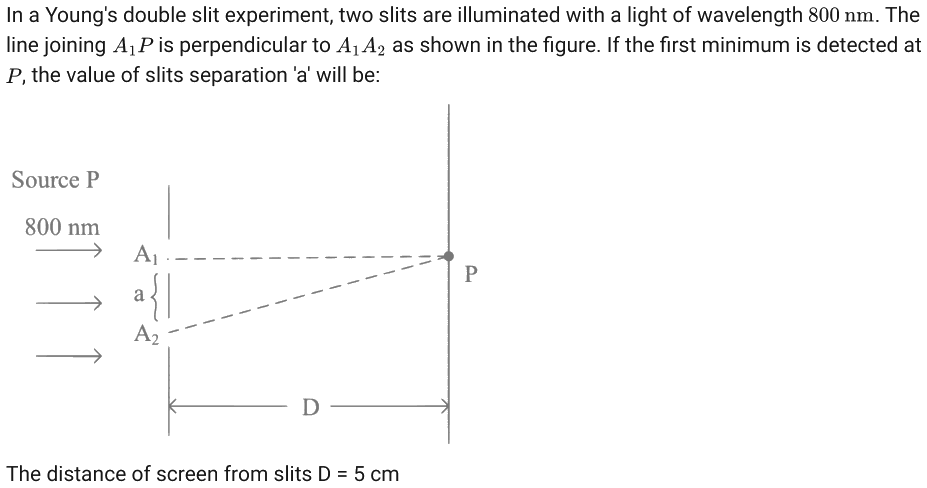
Answer: A
Unpolarised light is incident on the boundary between two dielectric media, whose dielectric constants are 2.8 (medium ) and 6.8 (medium ), respectively. To satisfy the condition, so that the reflected and refracted rays are perpendicular to each other, the angle of incidence should be the value of is __________. (Given for dielectric media, )
Answer: 7
In Young's double slits experiment, the position of bright fringe from the central maximum is 5 cm. The distance between slits and screen is 1 m and wavelength of used monochromatic light is 600 nm. The separation between the slits is :
Answer: A
An unpolarised light beam of intensity is passed through a polaroid P and then through another polaroid Q which is oriented in such a way that its passing axis makes an angle of relative to that of P. The intensity of the emergent light is
Answer: C
In a Young's double slit experiment, a laser light of 560 nm produces an interference pattern with consecutive bright fringes' separation of 7.2 mm. Now another light is used to produce an interference pattern with consecutive bright fringes' separation of 8.1 mm. The wavelength of second light is __________ nm.
Answer: 630
Two beams of light having intensities I and 4I interfere to produce a fringe pattern on a screen. The phase difference between the two beams are and at points A and B respectively. The difference between the resultant intensities at the two points is . The value of will be _________.
Answer: 2
Two coherent sources of light interfere. The intensity ratio of two sources is . For this interference pattern if the value of is equal to , then will be :
Answer: B
In Young's double slit experiment, the fringe width is . If the entire arrangement is placed in water of refractive index , then the fringe width becomes (in mm):
Answer: B
Find the ratio of maximum intensity to the minimum intensity in the interference pattern if the widths of the two slits in Young's experiment are in the ratio of 9 : 16. (Assuming intensity of light is directly proportional to the width of slits)
Answer: D
In Young's double slit experiment performed using a monochromatic light of wavelength , when a glass plate () of thickness is introduced in the path of the one of the interfering beams, the intensity at the position where the central maximum occurred previously remains unchanged. The value of x will be :
Answer: B
In a Young's double slit experiment, an angular width of the fringe is on a screen placed at away for particular wavelength of . The angular width of the fringe, when whole system is immersed in a medium of refractive index , is . The value of is ____.
Answer: 4
In Young's double slit experiment the two slits are 0.6 mm distance apart. Interference pattern is observed on a screen at a distance 80 cm from the slits. The first dark fringe is observed on the screen directly opposite to one of the slits. The wavelength of light will be ____________ nm.
Answer: 450
The two light beams having intensities and interfere to produce a fringe pattern on a screen. The phase difference between the beams is at point and at point . Then the difference between the resultant intensities at and will be :
Answer: B
Given below are two statements : Statement I : Davisson-Germer experiment establishes the wave nature of electrons. Statement II : If electrons have wave nature, they can interfere and show diffraction. In the light of the above statements choose the correct answer from the option given below :
Answer: A
The interference pattern is obtained with two coherent light sources of intensity ratio . And the ratio is . Then, the value of x will be equal to :
Answer: B
The width of one of the two slits in a Young's double slit experiment is three times the other slit. If the amplitude of the light coming from a slit is proportional to the slit-width, the ratio of minimum to maximum intensity in the interference pattern is x : 4 where x is ____________.
Answer: 1
