115 questions asked across 17 exam years, newest first
If the measured angular separation between the second minimum to the left of the central maximum and the third minimum to the right of the central maximum is in a single slit diffraction pattern recorded using light, then the width of the slit is _________ .
Answer: 6
A double slit interference experiment performed with a light of wavelength 600 nm forms an interference fringe pattern on a screen with 10 th bright fringe having its centre at a distance of 10 mm from the central maximum. Distance of the centre of the same 10 th bright fringe from the central maximum when the source of light is replaced by another source of wavelength 660 nm would be ________ mm .
Answer: 11
The Young's double slit interference experiment is performed using light consisting of 480 nm and 600 nm wavelengths to form interference patterns. The least number of the bright fringes of 480 nm light that are required for the first coincidence with the bright fringes formed by 600 nm light is
Answer: C
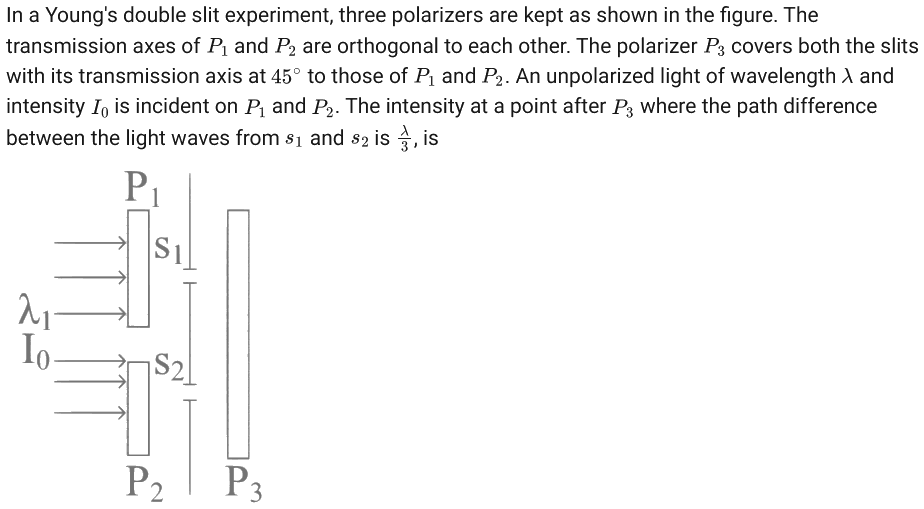
Answer: C
Young's double slit interference apparatus is immersed in a liquid of refractive index 1.44. It has slit separation of 1.5 mm . The slits are illuminated by a parallel beam of light whose wavelength in air is 690 nm . The fringe-width on a screen placed behind the plane of slits at a distance of 0.72 m , will be:
Answer: D
The width of one of the two slits in Young's double slit experiment is while that of the other slit is . If the ratio of the maximum to the minimum intensity in the interference pattern on the screen is then what is the value of ? (Assume that the field strength varies according to the slit width.)
Answer: D
Given below are two statements : one is labelled as Assertion (A) and the other is labelled as Reason (R). Assertion-(A) : If Young's double slit experiment is performed in an optically denser medium than air, then the consecutive fringes come closer. Reason-(R) : The speed of light reduces in an optically denser medium than air while its frequency does not change. In the light of the above statements, choose the most appropriate answer from the options given below :
Answer: C
In a Young's double slit experiment, the intensity at a point is of the maximum intensity, the minimum distance of the point from the central maximum is ______ . (Given : , , )
Answer: 200
Monochromatic light of wavelength is used in Young's double slit experiment. An interference pattern is obtained on a screen. When one of the slits is covered with a very thin glass plate (refractive index ), the central maximum is shifted to a position previously occupied by the bright fringe. The thickness of the glass-plate is ____ .
Answer: 4
A parallel beam of monochromatic light of wavelength passes through single slit of width. Angular divergence corresponding to second order minima would be ________ .
Answer: 6
Two slits are apart and the screen is located away from the slits. A light of wavelength is used. The width of each slit to obtain maxima of the double slit pattern within the central maximum of the single slit pattern is ____ .
Answer: 2
Two coherent monochromatic light beams of intensities and are superimposed. The difference between maximum and minimum possible intensities in the resulting beam is . The value of is ________.
Answer: 8
In a single slit experiment, a parallel beam of green light of wavelength passes through a slit of width . The transmitted light is collected on a screen away. The distance of first order minima from the central maximum will be . The value of is :
Answer: 275
Two wavelengths and are used in Young's double slit experiment. and . The minimum order of fringe produced by which overlaps with the fringe produced by is . The value of is ____.
Answer: 9
The width of one of the two slits in a Young's double slit experiment is 4 times that of the other slit. The ratio of the maximum to the minimum intensity in the interference pattern is:
Answer: D
A monochromatic light of wavelength is incident on the single slit of width . If the diffraction pattern is formed at the focus of the convex lens of focal length , the linear width of the central maximum is :
Answer: B
A microwave of wavelength falls normally on a slit of width . The angular spread of the central maxima of the diffraction pattern obtained on a screen away from the slit, will be :
Answer: A
In Young's double slit experiment, monochromatic light of wavelength is used. The slits are apart and screen is placed at away from slits. The distance from the centre of the screen where intensity becomes half of the maximum intensity for the first time is ________ .
Answer: 125
Two waves of intensity ratio cross each other at a point. The resultant intensities at that point, when (a) Waves are incoherent is (b) Waves are coherent is and differ in phase by . If then ____.
Answer: 13
When unpolarized light is incident at an angle of on a transparent medium from air, the reflected ray is completely polarized. The angle of refraction in the medium is:
Answer: C
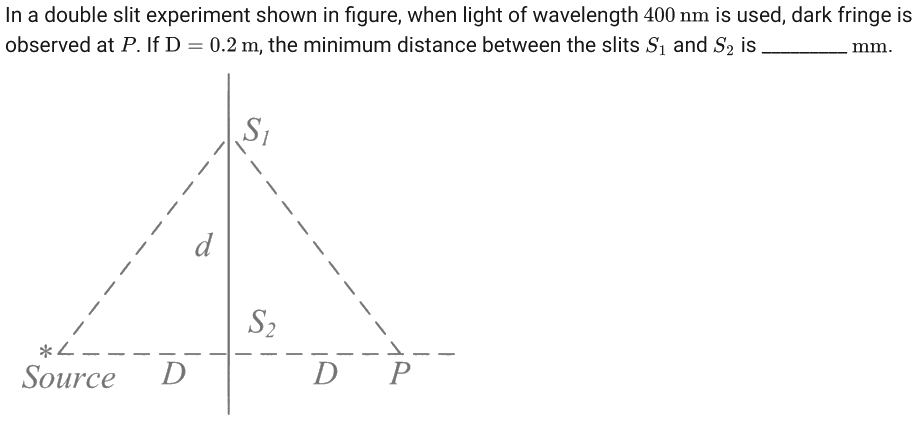
Answer: 0.2
In Young's double slit experiment, light from two identical sources are superimposing on a screen. The path difference between the two lights reaching at a point on the screen is . The ratio of intensity of fringe at this point with respect to the maximum intensity of the fringe is :
Answer: A
In a single slit diffraction pattern, a light of wavelength is used. The distance between the first and third minima in the diffraction pattern is found to be when the screen in placed away from slits. The width of the slit is _________ .
Answer: 2
A parallel beam of monochromatic light of wavelength is incident normally on a single narrow slit of width . The light is focused by convex lens on screen, placed on its focal plane. The first minima will be formed for the angle of diffraction of _______ (degree).
Answer: 30
In a Young's double slits experiment, the ratio of amplitude of light coming from slits is . The ratio of the maximum to minimum intensity in the interference pattern is:
Answer: B
