207 questions asked across 16 exam years, newest first
The ratio of surface tensions of mercury and water is given to be 7.5 while the ratio of their densities is 13.6. Their contact angles, with glass, are close to and , respectively. It is observed that mercury gets depressed by an amount h in a capillary tube of radius , while water rises by the same amount h in a capillary tube of radius . The ratio, , is then close to :
Answer: A
One mole of ideal gas passes through a process where pressure and volume obey the relation . Here and are constants. Calculate the change in the temperature of the gas if its volume changes form to
Answer: C
Water from a tap emerges vertically downwards with an initial speed of . The cross-sectional area of the tap is . Assume that the pressure is constant throughout the stream of water and that the flow is streamlined. The cross-sectional area of the stream, 0.15 m below the tap would be : (Take )
Answer: C
A submarine experiences a pressure of at a depth of in a sea. When it goes further to a depth of , it experiences a pressure of . Then is approximately (density of water and acceleration due to gravity ) :
Answer: C
In an experiment, brass and steel wires of length 1 m each with areas of cross section are used. The wires are connected in series and one end of the combined wire is connected to a rigid support and other end is subjected to elongation. The stress required to produce a net elongation of 0.2 mm is, [Given, the Young's Modulus for steel and brass are, respectively, and ]
Answer: A
A cubical block of side 0.5 m floats on water with 30% of its volume under water. What is the maximum weight that can be put on the block without fully submerging it under water? [Take, density of water = ]
Answer: B
When heat Q is supplied to a diatomic gas of rigid molecules, at constant volume its temperature increases by . the heat required to produce the same change in temperature, at a constant pressure is :
Answer: A
If 'M' is the mass of water that rises in a capillary tube of radius 'r', then mass of water which will rise in a capillary tube of radius '2r' is :
Answer: D
A wooden block floating in a bucket of water has 4/5 of its volume submerged. When certain amount of an oil is poured into the bucket, it is found that the block is just under the oil surface with half of its volume under water and half in oil. The density of oil relative to that of water is :-
Answer: C
An ideal gas occupies a volume of at a pressure of . The energy of the gas is :
Answer: B
A load of mass M kg is suspended from a steel wire of length 2m and radius 1.0 mm in Searle's apparatus experiment. The increase in length produced in the wire is 4.0 mm. Now the load is fully immersed in a liquid of relative density 2. The relative density of the material of load is 8. The new value of increase in length of the steel wire is:
Answer: C

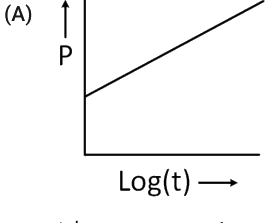
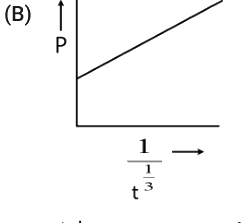
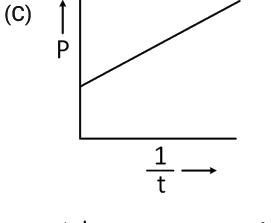
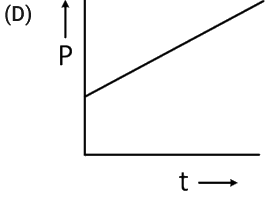
Answer: B
Drift speed of electrons, when of current flows in a copper wire of cross section , is . If the electron density in copper is the value of in mm/s is close to (Take charge of electron to be )
Answer: A
A small soap bubble of radius 4 cm is trapped inside another bubble of radius 6 cm without any contact. Let be the pressure inside the inner bubble and , the pressure outside the outer bubble. Radius of another bubble with pressure difference between its inside and outside would be :
Answer: B
A solid sphere of radius r made of a soft material of bulk modulus K is surrounded by a liquid in a cylindrical container. A massless piston of area a floats on the surface of the liquid, covering entire cross section of cylindrical container. When a mass m is placed on the surface of the piston to compress the liquid, the fractional decrement in the radius of the sphere, is:
Answer: D
The mass of a hydrogen molecule is . If hydrogen molecules strike, per second, a fixed wall of area at an angle of to the normal, and rebound elastically with a speed of , then the pressure on the wall is nearly:
Answer: A
A steel rail of length 5 m and area of cross section is prevented from expanding along its length while the temperature rises by . If coefficient of linear expansion and Young’s modulus of steel are and respectively, the force developed in the rail is approximately :
Answer: B
Two tubes of radii and , and lengths and , respectively, are connected in series and a liquid flows through each of them in stream line conditions. and are pressure differences across the two tubes. If is and is , then the radius will be equal to :
Answer: D
An open glass tube is immersed in mercury in such a way that a length of extends above the mercury level. The open end of the tube is then closed and sealed and the tube is raised vertically up by additional . What will be length of the air column above mercury in the tube now? (Atmospheric pressure of )
Answer: A
The pressure that has to be applied to the ends of a steel wire of length to keep its length constant when its temperature is raised by is: (For steel Young's modulus is and coefficient of thermal expansion is )
Answer: A
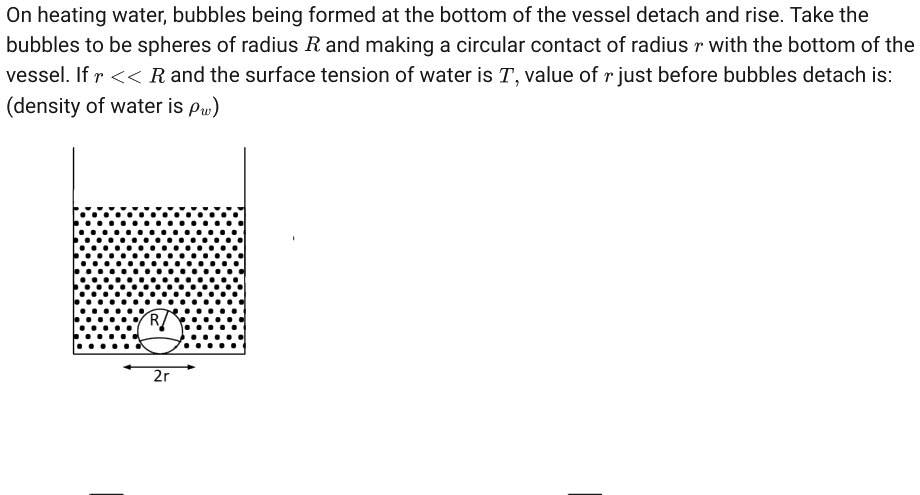
Answer: D
The terminal velocity of a small sphere of radius in a viscous liquid is proportional to
Answer: A
Water is flowing through a horizontal tube having cross-sectional areas of its two ends being and such that the ratio is 5. If the pressure difference of water between the two ends is , the velocity of water with which it enters the tube will be (neglect gravity effects)
Answer: A
A structural steel rod has a radius of and length of . A force stretches it along its length. Young's modulus of structural steel is . The percentage strain is about
Answer: A
A perfect gas at is heated at constant pressure so as to double its volume. The final temperature of the gas will be, close to
Answer: A
