147 questions asked across 19 exam years, newest first
The acceleration due to gravity is found upto an accuracy of 4% on a planet. The energy supplied to a simple pendulum of known mass 'm' to undertake oscillations of time period T is being estimated. If time period is measured to an accuracy of 3%, the accuracy to which E is known is ..............%
Answer: 14
Two simple harmonic motions are represented by the equations and . The amplitude of second motion is ............... times the amplitude in first motion.
Answer: 2
An object of mass 0.5 kg is executing simple harmonic motion. It amplitude is 5 cm and time period (T) is 0.2 s. What will be the potential energy of the object at an instant starting from mean position. Assume that the initial phase of the oscillation is zero.
Answer: A
A particle executes simple harmonic motion represented by displacement function as If the position and velocity of the particle at are 2 cm and respectively, then its amplitude is where the value of x is __________.
Answer: 2
A particle of mass 1 mg and charge q is lying at the mid-point of two stationary particles kept at a distance '2 m' when each is carrying same charge 'q'. If the free charged particle is displaced from its equilibrium position through distance 'x' (x << 1 m), the particle executes SHM. Its angular frequency of oscillation will be ____ rad/s if .
Answer: 6000
A pendulum bob has a speed of 3 m/s at its lowest position. The pendulum is 50 cm long. The speed of bob, when the length makes an angle of to the vertical will be (g = ) ____ m/s.
Answer: 2
In a simple harmonic oscillation, what fraction of total mechanical energy is in the form of kinetic energy, when the particle is midway between mean and extreme position.
Answer: B
is the time period of a simple pendulum at a place. If the length of the pendulum is reduced to times of its initial value, the modified time period is :
Answer: B
Three students and perform an experiment for determining the acceleration due to gravity (g) using a simple pendulum. They use different lengths of pendulum and record time for different number of oscillations. The observations are as shown in the table. | Student No. | Length of Pendulum (cm) | No. of oscillations (n) | Total time for n oscillations | Time period (s) | |---|---|---|---|---| | 1 | 64.0 | 8 | 128.0 | 16.0 | | 2 | 64.0 | 4 | 64.0 | 16.0 | | 3 | 20.0 | 4 | 36.0 | 9.0 | (Least count of length and Least count for time ) If and are the percentage errors in 'g' for students 1, 2 and 3 respectively, then the minimum percentage error is obtained by student no. ________.
Answer: 1
The time period of a simple pendulum is given by . The measured value of the length of pendulum is 10 cm known to a 1mm accuracy. The time for 200 oscillations of the pendulum is found to be 100 second using a clock of 1s resolution. The percentage accuracy in the determination of 'g' using this pendulum is 'x'. The value of 'x' to be nearest integer is :-
Answer: B
A particle performs simple harmonic motion with a period of 2 second. The time taken by the particle to cover a displacement equal to half of its amplitude from the mean position is . The value of 'a' to the nearest integer is _______.
Answer: 6
The function of time representing a simple harmonic motion with a period of is :
Answer: D
Time period of a simple pendulum is T inside a lift when the lift is stationary. If the lift moves upwards with an acceleration g/2, the time period of pendulum will be :
Answer: B
Assume that a tunnel is dug along a chord of the earth, at a perpendicular distance (R/2) from the earth's centre, where 'R' is the radius of the Earth. The wall of the tunnel is frictionless. If a particle is released in this tunnel, it will execute a simple harmonic motion with a time period :
Answer: A
If two similar springs each of spring constant are joined in series, the new spring constant and time period would be changed by a factor :
Answer: C
A particle is moving with uniform speed along the circumference of a circle of radius R under the action of a central fictitious force F which is inversely proportional to . Its time period of revolution will be given by :
Answer: D
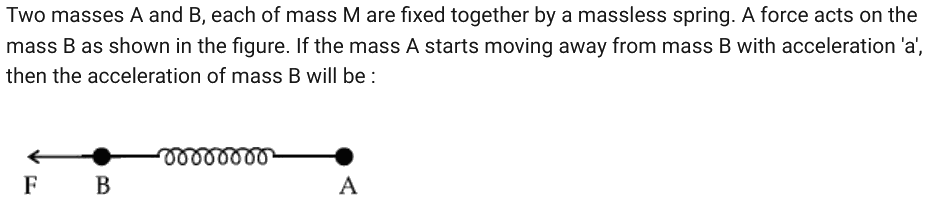
Answer: D
Given below are two statements : Statement I : A second's pendulum has a time period of 1 second. Statement II : It takes precisely one second to move between the two extreme positions. In the light of the above statements, choose the correct answer from the options given below :
Answer: B
Time period of a simple pendulum is T. The time taken to complete oscillations starting from mean position is . The value of is _________.
Answer: 7
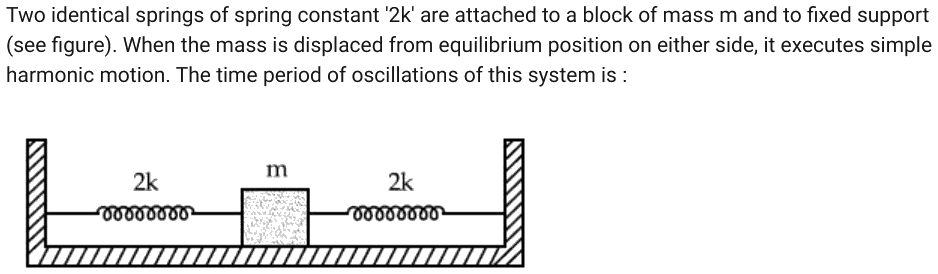
Answer: B
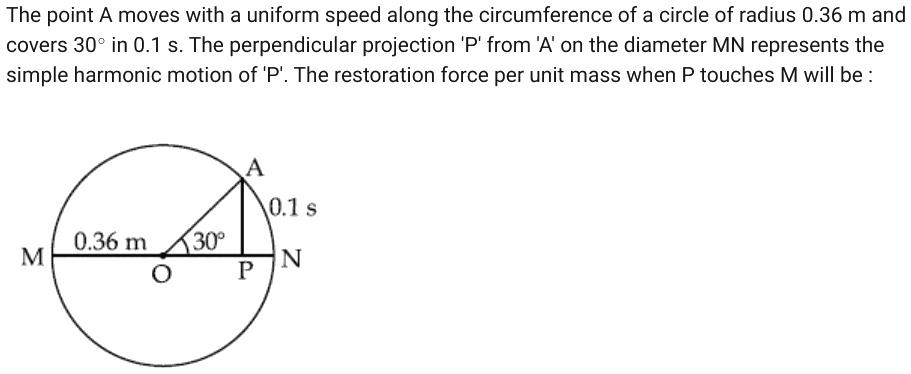
Answer: A
A block of mass m attached to a massless spring is performing oscillatory motion of amplitude 'A' on a frictionless horizontal plane. If half of the mass of the block breaks off when it is passing through its equilibrium point, the amplitude of oscillation for the remaining system become . The value of is :
Answer: D
A small circular loop of conducting wire has radius a and carries current I. It is placed in a uniform magnetic field B perpendicular to its plane such that when rotated slightly about its diameter and released, it starts performing simple harmonic motion of time period T. If the mass of the loop is m then :
Answer: D
A simple pendulum is being used to determine the value of gravitational acceleration g at a certain place. The length of the pendulum is 25.0 cm and a stop watch with 1s resolution measures the time taken for 40 oscillations to be 50 s. The accuracy in g is :
Answer: A
A LCR circuit behaves like a damped harmonic oscillator. Comparing it with a physical spring-mass damped oscillator having damping constant 'b', the correct equivalence would be:
Answer: C
