46 questions asked across 11 exam years, newest first
Match the List-I with List-II : Correct match is -
Answer: A
A chloride salt solution acidified with dil. gives a curdy white precipitate, [A], on addition of . [A] on treatment with gives a clear solution B. A and B are respectively :
Answer: B
Given below are two statements, one is labelled as Assertion A and the other is labelled as Reason R Assertion A : The alkali metals and their salts impart characteristic colour to reducing flame. Reason R : Alkali metals can be detected using flame tests. In the light of the above statements, choose the most appropriate answer from the options given below :
Answer: A
cation gives a prussian blue precipitate on addition of potassium ferrocyanide solution due to the formation of :
Answer: D
Correct formula of the compound which gives a white precipitate with solution, but not with solution, is :
Answer: A
s-block element which cannot be qualitatively confirmed by the flame test is :
Answer: D
In the flame test of a mixture of salts, a green flame with blue centre was observed. Which one of the following cations may be present?
Answer: A
To an aqueous solution containing ions such as , , , , , and was added conc. , followed by . The total number of cations precipitated during this reaction is/are :
Answer: A
An inorganic Compound 'X' on treatment with concentrated produces brown fumes and gives dark brown ring with in presence of concentrated . Also Compound 'X' gives precipitate 'Y', when its solution in dilute is treated with gas. The precipitate 'Y' on treatment with concentrated followed by excess of further gives deep blue coloured solution, Compound 'X' is :
Answer: C
Ceric ammonium nitrate and /alc. KOH are used for the identification of functional groups present in _________ and _________ respectively.
Answer: C
Seliwanoff test and Xanthoproteic test are used for the identification of ___________ and ________ respectively.
Answer: A
The volume (in mL) of 0.125 M required to quantitatively precipitate chloride ions in 0.3 g of is _______.
Answer: 26.8 to 27




Answer: B
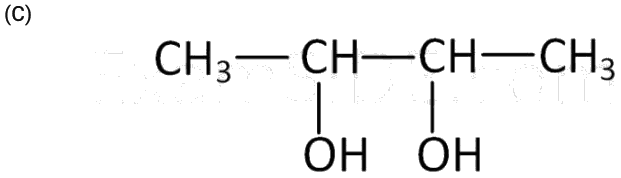
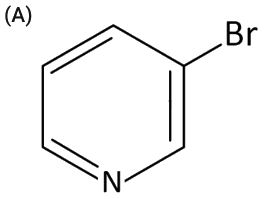
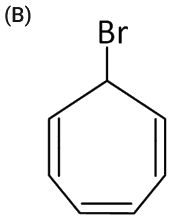
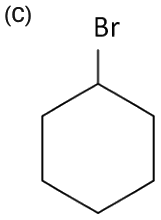
Which one of the following is likely to give a precipitate with solution ?
Answer: B
Among the following, the molecule expected to be stabilized by anion formation is :
Answer: A
The calculated spin-only magnetic moments (BM) of the anionic and cationic species of , respectively, are :
Answer: C

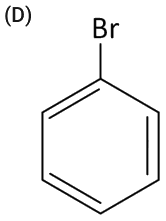
Answer: B
A white sodium salt dissolves readily in water to give a solution which is neutral to litmus. When silver nitrate solution is added to the aformentioned solution, a white precipitate is obtained which does not dissolve in dil. nitric acid. The anion is :
Answer: C
Which type of ‘defect’ has the presence of cations in the interstitial sites?
Answer: D
A solution containing a group-IV cation gives a precipitate on passing . A solution of this precipitate in dil.HCl produces a white precipitate with solution and bluish-white precipitate with basic potassium ferrocyanide. The cation is :
Answer: D
The edge length of a face centered cubic cell of an ionic substance is 508 pm. If the radius of the cation is 110 pm, the radius of the anion is :
Answer: D
