179 questions asked across 20 exam years, newest first
A solution of sodium sulphate contains of ions per kilogram of water. The molality of ions in that solution in is :
Answer: B
A water sample has ppm level concentration of the following metals : Fe = 0.2; Mn = 5.0; Cu = 3.0; Zn = 5.0. The metal that makes the water sample unsuitable for drinking is :
Answer: B
of gas A and x moles of gas B exert a pressure of in a container of volume at . Given R is the gas constant in , x is :
Answer: D
An unknown chlorohydrocarbon has 3.55% of chlorine. If each molecule of the hydrocarbon has one chlorine atom only; chlorine atoms present in of chlorohydrocarbon are : (Atomic wt. of ; Avogadro constant )
Answer: A
The ratio of mass percent of C and H of an organic compound is . If one molecule of the above compound contains half as much oxygen as required to burn one molecule of compound completely to and . The empirical formula of compound is
Answer: A
A solution is prepared by mixing 8.5 g of and 11.95 g of . If vapour pressure of and at 298 K are 415 and 200 mmHg respectively, the mole fraction of in vapour form is : (Molar mass of )
Answer: C

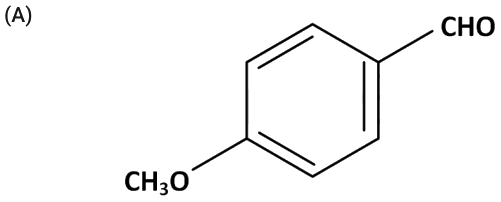
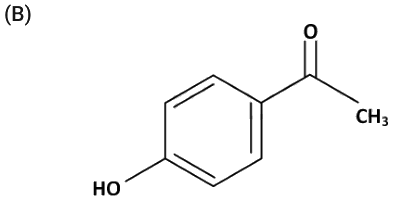
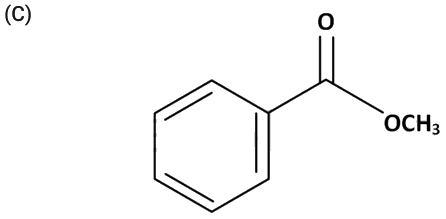
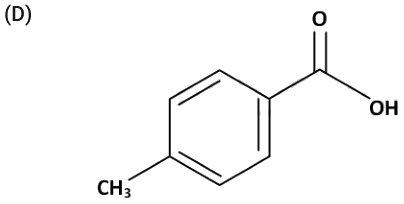
Answer: A
Excess of (aq) was added to 100 mL of (aq) resulting into 2.14 g of . The molarity of (aq) is : (Given molar mass of and molar mass of )
Answer: A
The heats of combustion of carbon and carbon monoxide are and , respectively. The heat of formation (in ) of carbon monoxide per mole is :
Answer: C
The molecular formula of a commercial resin used for exchanging ions in water softening is (Mol. Wt. 206). What would be the maximum uptake of ions by the resin when expressed in mole per gram resin?
Answer: B
For the non – stoichiometre reaction , the following kinetic data were obtained in three separate experiments, all at . | Initial Concentration (A) | Initial Concentration (B) | Initial rate of formation of C () | | :--- | :--- | :--- | | | | | | | | | | | | | The rate law for the formation of C is:
Answer: B
One mole of an ideal gas is expanded isothermally and reversibly to half of its initial pressure. for the process in is
Answer: B
One mole of and two moles of were heated in a closed vessel of one-litre capacity at 1098 K. At equilibrium 1.6 moles of were found. The equilibrium constant of the reaction would be
Answer: C
The ppm level of in a sample of a tooth paste containing is
Answer: A
The concentrated sulphuric acid that is peddled commercially is 95% by weight. If the density of this commercial acid is , the molarity of this solution is
Answer: A
The energy required to break one mole of bonds in is . The longest wavelength of light capable of breaking a single bond is ( and )
Answer: D
One mole of a symmetrical alkene on ozonolysis gives two moles of an aldehyde having a molecular mass of 44 u. The alkene is
Answer: C
If of water is introduced into a flask at 300 K, how many moles of water are in the vapour phase when equilibrium is established ? (Given : Vapour pressure of at 300 K is 3170 Pa ; )
Answer: D
The number of stereoisomers possible for a compound of the molecular formula is :
Answer: B
How many moles of magnesium phosphate will contain of oxygen atoms?
Answer: D
Density of a solution of acetic acid in water is . The molality of the solution is
Answer: A
Two solutions of a substance (non electrolyte) are mixed in the following manner. 480 ml of 1.5 M first solution + 520 ml of 1.2 M second solution. What is the molarity of the final mixture?
Answer: B
If we consider that 1/6, in place of 1/12, mass of carbon atom is taken to be the relative atomic mass unit, the mass of one mole of the substance will
Answer: B
If the bond dissociation energies of , and (all diatomic molecules) are in the ratio of and for the formation of is . The bond dissociation energy of will be :
Answer: D
An ionic compound has a unit cell consisting of A ions at the corners of a cube and B ions on the centres of the faces of the cube. The empirical formula for this compound would be :
Answer: C
