179 questions asked across 20 exam years, newest first
A solution of two components containing moles of the component and moles of the component is prepared. and are the molecular weights of component 1 and 2 respectively. If d is the density of the solution in , is the molarity and is the mole fraction of the component, then can be expressed as :
Answer: B
A solution of phenol in chloroform when treated with aqueous NaOH gives compound P as a major product. The mass percentage of carbon in P is ______. (to the nearest integer) (Atomic mass : C = 12; H = 1; O = 16)
Answer: 69



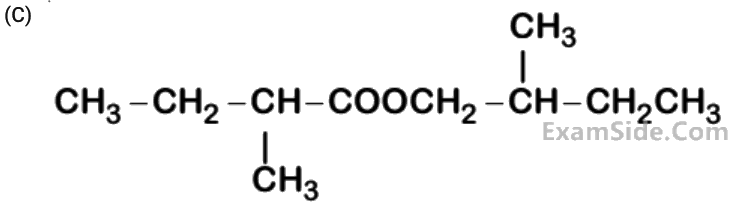
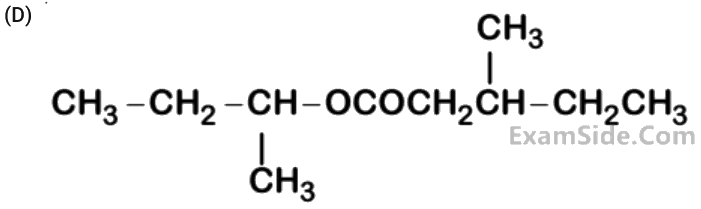
Answer: D, B
The strengths of 5.6 volume hydrogen peroxide (of density 1 g/mL) in terms of mass percentage and molarity (M), respectively, are: (Take molar mass of hydrogen peroxide as 34 g/mol)
Answer: D
Complex A has a composition of . If the complex on treatment with loses of its original mass, the correct molecular formula of A is : [Given: atomic mass of and ]
Answer: B
A mixture of one mole each of , and each are enclosed in a cylinder of volume at temperature . If the partial pressure of is , the total pressure of the gases in the cylinder is :
Answer: C
molecules are present in of a substance 'x'. The molarity of a solution containing of substance 'x' in solution is ____
Answer: 25
Two compounds A and B with same molecular formula () undergo Grignard's reaction with methylmagnesium bromide to give products C and D. Products C and D show following chemical tests. | Test | C | D | | :--- | :--- | :--- | | Ceric ammonium nitrate Test | Positive | Positive | | Lucas Test | Turbidity obtained after five minutes | Turbidity obtained immediately | | Iodoform Test | Positive | Negative | C and D respectively are :
Answer: D
The ratio of the mass percentages of ‘C & H’ and ‘C & O’ of a saturated acyclic organic compound ‘X’ are 4 : 1 and 3 : 4 respectively. Then, the moles of oxygen gas required for complete combustion of two moles of organic compound ‘X’ is ________.
Answer: 5
The hardness of a water sample containing expressed as equivalents (in ppm) is _______. (molar mass of is )
Answer: 100
The molarity of in a sample which has density 1.4 g/mL and mass percentage of 63% is _______. (Molecular Weight of )
Answer: 14
The first and second ionisation enthalpies of a metal are 496 and , respectively. How many moles of and , respectively, will be needed to react completely with 1 mole of the metal hydroxide ?
Answer: B
Biochemical Oxygen Demand (BOD) is the amount of oxygen required (in ppm) :
Answer: D
10.30 mg of is dissolved into a liter of sea water of density 1.03 g/mL. The concentration of in ppm is_______.
Answer: 10
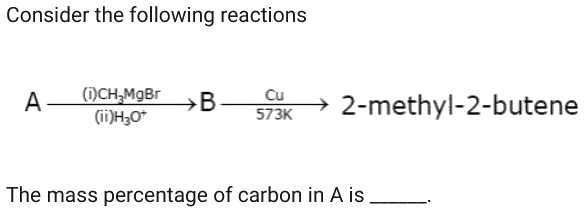
Answer: 66.66 to 66.67
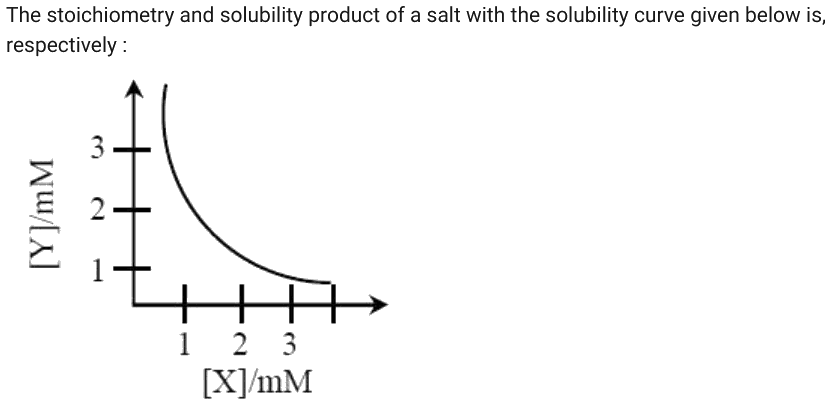
Answer: C
The mole fraction of a solvent in aqueous solution of a solute is 0.8. The molality (in ) of the aqueous solution is :
Answer: C
5 moles of weigh and 10 moles of weigh . The molar mass of A () and molar mass of B () in are:
Answer: C
The difference between and (), when the combustion of one mole of heptane(l) is carried out at a temperature T, is equal to :
Answer: A
What would be the molality of 20% (mass/ mass) aqueous solution of KI? (molar mass of KI )
Answer: A
The percentage composition of carbon by mole in methane is :
Answer: B
5 moles of an ideal gas at 100 K are allowed to undergo reversible compression till its temperature becomes 200 K. If , calculate and for this process. ()
Answer: A
Water samples with BOD values of 4 ppm and 18 ppm, respectively are :
Answer: A
The volume of gas A is twice than that of gas B. The compressibility factor of gas A is thrice than that of gas B at same temperature. The pressures of the gases for equal number of moles are -
Answer: A
8 g of NaOH is dissolved in 18g of . Mole fraction of NaOH in solution and molality (in ) of the solution respectively are -
Answer: C
