127 questions asked across 18 exam years, newest first
The reaction occurs in which of the given galvanic cell.
Answer: B
The number of incorrect statements from the following is ____. A. The electrical work that a reaction can perform at constant pressure and temperature is equal to the reaction Gibbs energy. B. cell is dependent on the pressure. C. D. A cell is operating reversibly if the cell potential is exactly balanced by an opposing source of potential difference.
Answer: 1
The standard electrode potential of in aqueous solution does not depend on
Answer: C
The product, which is not obtained during the electrolysis of brine solution is :
Answer: D
The standard reduction potentials at for the following half cells are given below: The number of metal(s) which will be oxidized by in aqueous solution is ___________.
Answer: 3
At what pH, given half cell will have electrode potential of ? ________ (Nearest Integer) Given
Answer: 3
Which one of the following statements is correct for electrolysis of brine solution?
Answer: D
The resistivity of a solution of an electrolyte is . Its molar conductivity is ___________ . (Nearest integer)
Answer: 25
Given below are two statements : one is labelled as Assertion (A) and the other is labelled as Reason (R). Assertion (A) : In expensive scientific instruments, silica gel is kept in watch-glasses or in semipermeable membrane bags. Reason (R) : Silica gel adsorbs moisture from air via adsorption, thus protects the instrument from water corrosion (rusting) and / or prevents malfunctioning. In the light of the above statements, choose the correct answer from the options given below :
Answer: A
Consider the cell When the potential of the cell is at , the ratio is ___________. (Nearest integer) Given :
Answer: 10
The standard electrode potential for V, Cr, Mn & Co are V, V, + 1.57 V and + 1.97 V, respectively. The metal ions which can liberate from a dilute acid are :
Answer: C
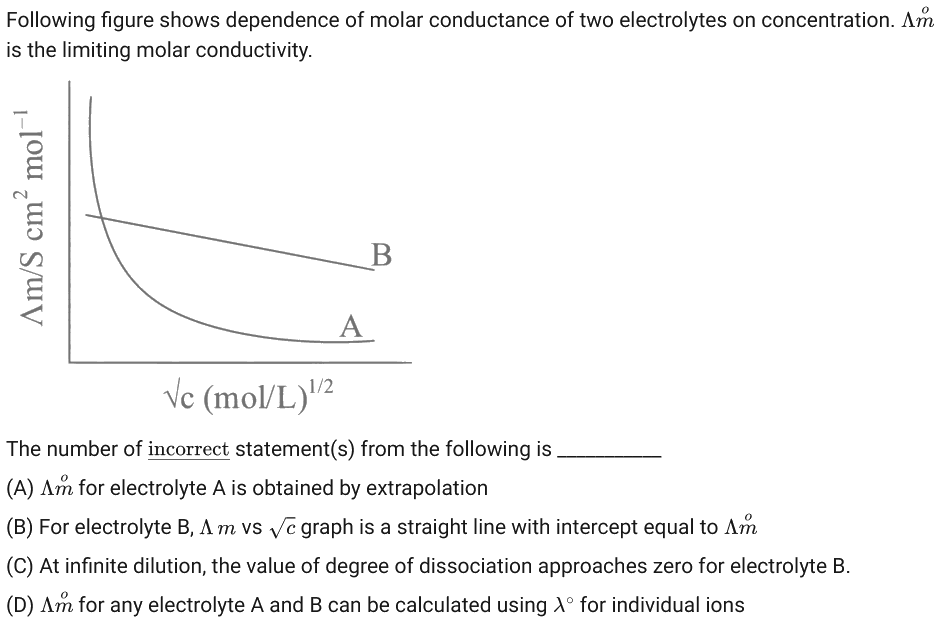
Answer: 2
The equilibrium constant for the reaction is at . The magnitude of standard electrode potential of if is ____ . (Nearest integer) Given :
Answer: 17
Resistance of a conductivity cell (cell constant ) filled with solution of is (labelled as solution 1). When the same cell is filled with solution of , the resistance is (labelled as solution 2). The ratio of molar conductivity of solution 1 and solution 2 is i.e. . The value of is __________. (Nearest integer) Given, molar mass of is .
Answer: 1000
For a cell, the cell potential is found to be at . The magnitude of standard electrode potential for is ____ .
Answer: 34
Match List - I with List - II. | | List - I | | List - II | |---|---|---|---| | (A) | | (I) | Primary battery | | (B) | | (II) | Discharging of secondary battery | | (C) | | (III) | Fuel cell | | (D) | | (IV) | Charging of secondary battery | Choose the correct answer from the options given below:
Answer: C
Which of the following methods are not used to refine any metal? A. Liquation B. Calcination C. Electrolysis D. Leaching E. Distillation Choose the correct answer from the options given below:
Answer: A
The conductivity of a solution of complex with formula corresponds to electrolyte, then the primary valency of central metal ion is _________.
Answer: 3
Given below are two statements : Statement I : For KI, molar conductivity increases steeply with dilution Statement II : For carbonic acid, molar conductivity increases slowly with dilution In the light of the above statements, choose the correct answer from the options given below :
Answer: B
The molar conductivity of a conductivity cell filled with 10 moles of solution is and that of 20 moles another identical cell having solution is . The conductivities exhibited by these two cells are same. The relationship between and is
Answer: A
The spin-only magnetic moment value of ion (in gaseous state) from the pairs , , and that has negative standard electrode potential, is ____ [Nearest integer]
Answer: 4
For the given reactions the electrode potentials are ; and . The magnitude of standard electrode potential for i.e. is ____ . (Nearest integer)
Answer: 16
The limiting molar conductivities of , and are , and , respectively (all at ). The limiting molar conductivity of at this temperature is ____ .
Answer: 14
In 3d series, the metal having the highest standard electrode potential is :
Answer: C
Consider the following reaction: The dihedral angle in product A in its solid phase at 110 K is :
Answer: C
