118 questions asked across 19 exam years, newest first
The effect of temperature on spontaneity of reactions are represented as : | | | | Temperature | Spontaneity | |---|---|---|---|---| | (A) | | | any T | Non spontaneous | | (B) | | | low T | spontaneous | | (C) | | | low T | Non spontaneous | | (D) | | | any T | spontaneous | The incorrect combinations are :
Answer: D
The bond dissociation enthalpy of calculated from the given data is ____ . (Nearest integer) [Given : is a pure ionic compound and forms a diatomic molecule in gaseous state]
Answer: 200
Given below are two statements : Statement (I) : The oxidation state of an element in a particular compound is the charge acquired by its atom on the basis of electron gain enthalpy consideration from other atoms in the molecule. Statement (II) : bond formation is more prevalent in second period elements over other periods. In the light of the above statements, choose the most appropriate answer from the options given below :
Answer: C
For the reaction at , , and . The reaction will become spontaneous above ________ .
Answer: 2000
The correct order of first ionization enthalpy values of the following elements is : (A) O (B) N (C) Be (D) F (E) B Choose the correct answer from the options given below :
Answer: C
The enthalpy of formation of ethane () from ethylene by addition of hydrogen where the bond-energies of , , , are , , and respectively is ____
Answer: 125
The correct order of the first ionization enthalpy is
Answer: B
The transition metal having highest ionisation enthalpy is :
Answer: A
The correct sequence of electron gain enthalpy of the elements listed below is A. Ar B. Br C. F D. S Choose the most appropriate from the options given below:
Answer: B
Given below are two statements : one is labelled as Assertion A and the other is labelled as Reason R : Assertion A : The first ionisation enthalpy decreases across a period. Reason R : The increasing nuclear charge outweighs the shielding across the period. In the light of the above statements, choose the most appropriate from the options given below :
Answer: A
The element having the highest first ionization enthalpy is
Answer: D
Standard enthalpy of vapourisation for is . Heat required for vapourisation of of at constant temperature is _________ kJ. (Given molar mass in ; )
Answer: 56
For a certain thermochemical reaction at , , , log equilibrium constant () is _______ .
Answer: 37
What happens when methane undergoes combustion in systems A (Adiabatic system) and B (Diathermic container) respectively?
Answer: B
Given below are two statements, one is labelled as Assertion A and the other is labelled as Reason R. Assertion A : Isotopes of hydrogen have almost same chemical properties, but difference in their rates of reaction. Reason R : Isotopes of hydrogen have different enthalpy of bond dissociation. In the light of the above statements, choose the most appropriate answer from the options given below:
Answer: D
Identify the correct order of standard enthalpy of formation of sodium halides :
Answer: A
One mole of an ideal gas at is in a vessel of thermally conducting walls, which are in contact with the surroundings. It undergoes isothermal reversible expansion from to against a constant pressure of . The change in entropy of the surroundings ( ) is _________ (Nearest integer) Given: .
Answer: 3
For elements and , the correct order of first ionization enthalpy is
Answer: D
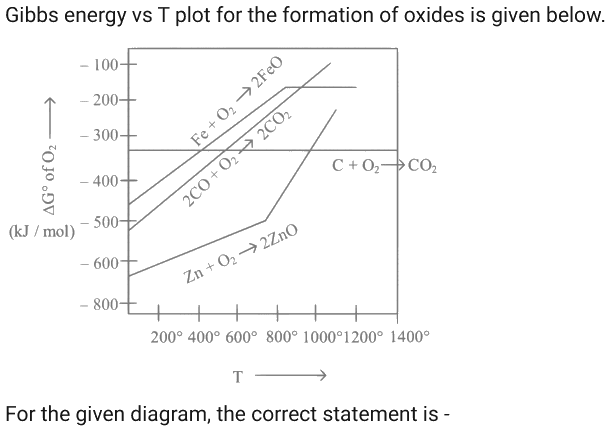
Answer: A
The number of endothermic process/es from the following is _________. A. B. C. D. E. Dissolution of ammonium chloride in water
Answer: 4
When a electric heater is immersed in a gas for in a constant volume container with adiabatic walls, the temperature of the gas rises by . The heat capacity of the given gas is ___________ (Nearest integer)
Answer: 1200
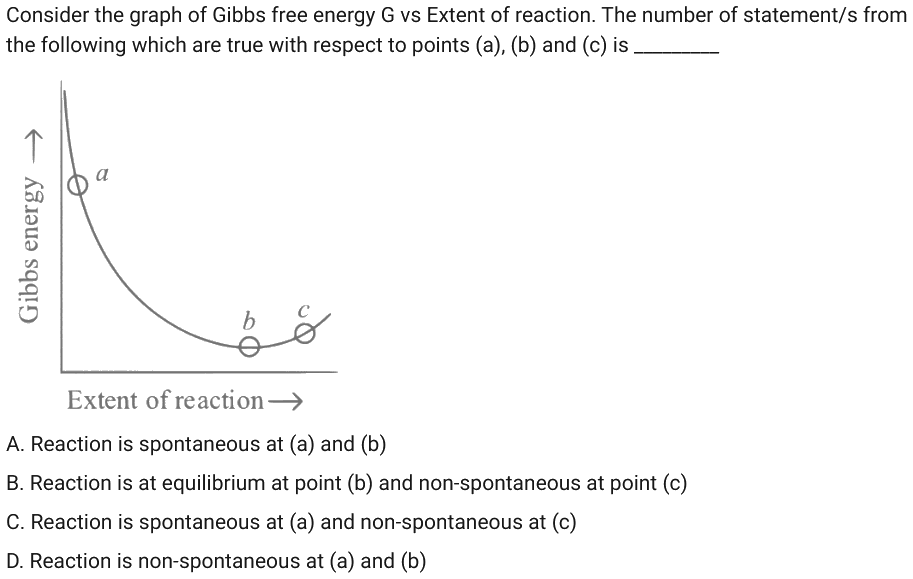
Answer: 2
Ion having highest hydration enthalpy among the given alkaline earth metal ions is :
Answer: C
Consider the following data The heat of formation of is ___________ (Nearest integer).
Answer: 278
At , the enthalpy of the following processes are given : | Reaction | Enthalpy | | :--- | :--- | | | | | | | | | | | | | What would be the value of X for the following reaction ? ________ (Nearest integer)
Answer: 499
