174 questions asked across 18 exam years, newest first
In molecule, the hybridization of carbon 1, 2, 3 and 4 respectively, are :
Answer: A
Which among the following species has unequal bond lengths?
Answer: D
If molecule is a polar molecule, a possible geometry of is
Answer: B
The molecular geometry of is octahedral. What is the geometry of (including lone pair(s) of electrons, if any)?
Answer: B
If enthalpy of atomisation for is x kJ/mol and bond enthalpy for is y kJ/mol, the relation between them :
Answer: C
Chlorine reacts with hot and concentrated NaOH and produces compounds (X) and (Y). Compound (X) gives white precipitate with silver nitrate solution. The average bond order between Cl and O atoms in (Y) is.
Answer: 1.66 to 1.67
The bond order and the magnetic characteristics of are :
Answer: C
The number of hybridised carbons present in "Aspartame" is
Answer: 9
The C–C bond length is maximum in :
Answer: B
The isoelectronic set of ions is :
Answer: C
Among the following species, the diamagnetic molecule is
Answer: A
The ion that has hybridization for the central atom, is :
Answer: B
Among the following molecules / ions, which one is diamagnetic and has the shortest bond length?
Answer: B
In Wilkinson's catalyst, the hybridization of central metal ion and its shape are respectively :
Answer: C
Which of the following conversions involves change in both shape and hybridisation ?
Answer: D
Identify the pair in which the geometry of the species is T-shape and square - pyramidal, respectively :
Answer: C
The decreasing order of bond angles in and is :
Answer: B
In hydrogen azide (above) the bond orders of bond (I) and (II) are :
Answer: A
Total number of lone pair of electrons in ion is
Answer: B
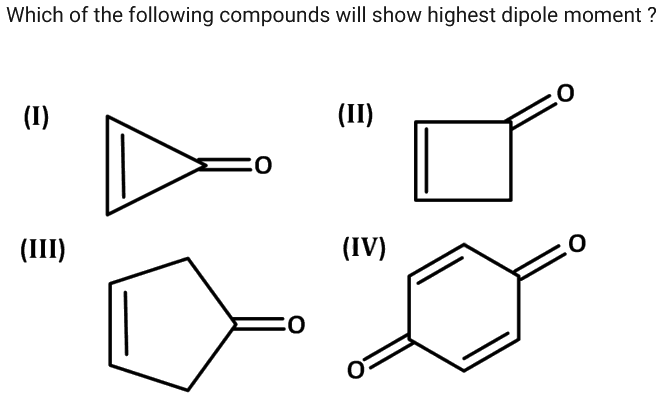
Answer: A
Which of the following is paramagnetic ?
Answer: D
hybridization is not displayed by :
Answer: D
The species in which the atom is in a state of hybridization is :
Answer: A
Dipole moment is shown by
Answer: A
The formation of molecular complex results in a change in hybridization of boron
Answer: B
