174 questions asked across 18 exam years, newest first
The of different types of half cells are as follows: | A | B | C | D | |---|---|---|---| | | | | | (Where E is the electromotive force) Which of the above half cells would be preferred to be used as reference electrode?
Answer: C
Amongst , , and , the number of species with two lone pairs of electrons is ____.
Answer: 2
The pair, in which ions are isoelectronic with is :
Answer: D
Amongst , , , , and , the number of molecules with non-zero net dipole moment is ____.
Answer: 3
The correct order of bond orders of , and is, respectively
Answer: B
Number of paramagnetic oxides among the following given oxides is ____. , , , , and
Answer: A
The bond order and magnetic behaviour of ion are respectively :
Answer: A
Given below are two statements : Statement I : , and are hybridised. Statement II : and are paramagnetic and have 4 and 5 unpaired electrons, respectively. In the light of the above statements, choose the correct answer from the options given below :
Answer: D
The number of sigma bonds in is ____.
Answer: 10
In the following the correct bond order sequence is :
Answer: C
The set having ions which are coloured and paramagnetic both is :
Answer: A
According to the valence bond theory the hybridization of central metal atom is for which one of the following compounds?
Answer: B
A s-block element (M) reacts with oxygen to form an oxide of the formula . The oxide is pale yellow in colour and paramagnetic. The element (M) is :
Answer: D
The number of lone pairs of electrons on the central I atom in is ________.
Answer: 3
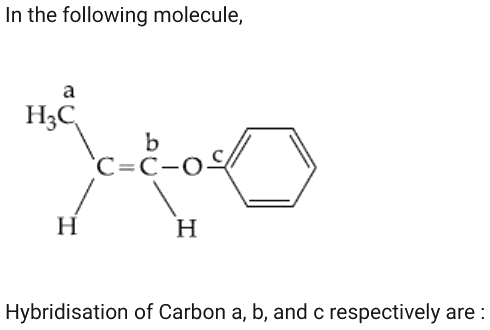
Answer: A
The secondary valency and the number of hydrogen bonded water molecule(s) in , respectively, are :
Answer: B
Match List - I with List - II : Choose the most appropriate answer from the options given below :
Answer: D
The number of species below that have two lone pairs of electrons in their central atom is ____. (Round off to the Nearest Integer). , , , , , , ,
Answer: 2
A xenon compound 'A' upon partial hydrolysis gives . The number of lone pair of electrons present in compound A is ____. (Round off to the Nearest Integer)
Answer: 19
Given below are two statements : one is labeled as Assertion A and the other is labelled as Reason R : Assertion A : The bond angle in water molecule is . Reason R : The lone pair - lone pair repulsion of electrons is higher than the bond pair - bond pair repulsion. In the light of the above statements, choose the correct answer from the options given below :
Answer: A
Assertion A : Enol form of acetone exists in quantity. However, the enol form of acetyl acetone exists in approximately quantity. Reason R : Enol form of acetyl acetone is stabilized by intramolecular hydrogen bonding, which is not possible in enol form of acetone. Choose the correct statement :
Answer: D
In chromotography technique, the purification of compound is independent of :
Answer: C
Given below are two statements : one is labelled as Assertion A and the other is labelled as Reason R. Assertion A : Dipole-dipole interactions are the only non-covalent interactions, resulting in hydrogen bond formation. Reason R : Fluorine is the most electronegative element and hydrogen bonds in HF are symmetrical. In the light of the above statements, choose the most appropriate answer from the options given below :
Answer: C
Given below are two statements : Statement I : o-Nitrophenol is steam volatile due to intramolecular hydrogen bonding. Statement II : o-Nitrophenol has high melting due to hydrogen bonding. In the light of the above statements, choose the most appropriate answer from the options given below :
Answer: B
Match List - I with List - II. | List - I (Molecule) | List - II (Bond order) | | :--- | :--- | | (a) | (i) 1 | | (b) | (ii) 2 | | (c) | (iii) 0 | | (d) | (iv) 3 | Choose the correct answer from the options given below :
Answer: C
